For those who are new to my episode reviews, you can find the post where I establish my point criteria here
Overview – On Earth, Detroit, in the early 21st
Century, a man is kidnapping and bringing people to an abandoned building under
the orders of a mysterious unseen person. It turns out that a trio of Reptilian
Xindi have traveled to the past to gather information from humans of different
blood types to create a biological weapon. In the 22nd Century,
Captain Archer is contacted by Daniels, who informs him of what the Xindi are
up to. Archer and T’Pol travel back 150 years to find ans stop the Xindi team.
As they race to stop the Xindi, they find themselves out of their element in
our day.
Score: 9/10 – There have been many different Trek
stories involving the characters going back to our time, and this was
Enterprise’s turn. In the spirit of “Assignment: Earth”, “Future’s End”, and
“Star Trek IV: The Voyage Home”, the crew go back in time to save humanity. It
made sense that Daniels insisted that Archer only be accompanied by T’Pol, and
it helped T’Pol come to grips with the fact that her traditional Vulcan beliefs
about time travel were inaccurate. There is the standard “fish-out-of-water”
moments. I liked how T’Pol uses her tricorder to get money from an ATM machine,
and Archer takes some time getting used to driving a vehicle. The action and
pacing of the episode are great and the concept of creating a bio weapon based
on human blood types is a different approach. Aside from the captain and first
officer, we only see Tucker and hear Reed over the comm system. Everyone else
is absent from this episode. While that is a shame, it does allow the story to
be streamlined to fit as much present day Earth stuff into it. Leland Orser
makes his fourth (and to date, final) appearance in Star Trek, and his character
of Loomis is the right mix of loser and sleazebag. A great episode
overall.
Relevance – 2 points. Daniels is back, and this
carries forward the temporal cold war story along, as well as T’Pol finally
receiving evidence that time travel is possible. The Reptilians found in 2004
are used by Archer to convince Degra that something is not right with the
Xindi’s plan.
Continuity - 3 points. Everything checks out here.
With only three of our characters being shown, and just two of them go back in
time, we only have those two to really look at. Archer and T’Pol are right on
cue for how I would have expected them to act. They did very little to upset
the timeline (except for maybe Loomis), so story continuity checks out. And
everything is fine in the Star Trek universe, so that gets a point here as
well.
Character Development – 2 points. With only T’Pol and
Archer getting any real attention, and most of the rest of them not being seen,
it does allow us to have some growth here. While these two seasoned officers
are in unfamiliar territory in 21st Century Detroit, they are able
to adapt much more quickly than others we have seen. As previously mentioned,
T’Pol does get a chance to re-evaluate her views on time travel, which is big
for her. Both of them are pushed to the limit, both in dealing with Loomis and
the Xindi. This gives us a further glimpse into not only their psyche but in
how the overarching crisis is affecting them.
Social Commentary – 2 points. The character of
Loomis is very relatable, likely due to the episode being set in our own time.
He is motivated by greed. He is willing to compromise his integrity to earn
some good money. While he is not evil, per se, he is a bit of a jerk and
clearly has no qualms about taking innocent people. His final fate is fitting
as he gets carted off by the police. He represents a loser side of humanity. We
all know someone like this, and sometimes we feel the temptation to be the
same.
Cool Stuff – 1 point. A point for the idea of using
human blood types as a basis for a bio weapon. I’m not sure if that has ever
been done before (in fiction, of course). As good as this episode is, this is
really the only cool thing to stand out.
Rank – Captain (19
points). This
is a great episode for the third season. It is a rare episode of this season
that can be enjoyed on its own without knowing much of what happened before. A
good solid story that does a very good telling of the time-traveler “fish-out-of-water”
scenario without getting too goofy or serious.
If you would like to check out my other episode reviews for Enterprise, simply click here.
If you would like to read an episode review from any of the Trek series, click the following link to get to the series catalog. If the episode you want reviewed has not been done yet, then feel free to request it in the comments and I will see what I can do.
Thirty years of TNG, and the debates about who the better captain was continue. Despite all of that, it is difficult to argue that while Kirk could drop kick with the best of them, Picard was most devastating with his words. There have been many great speeches that Jean-Luc delivered over the seven seasons and four feature films, and we all have our favourites. Some of them are motivational, some of them cut the soul deep, some are humorous, and some consist of him not saying much at all. One thing is certain, when Captain Jean-Luc Picard speaks, people listen. Here are my Top 10 Picard Speeches. Let me know if you think I over-looked any in the comment section.
10. Ensigns of Command – “Pursuant to Paragraph 1 290, I hereby
formally request third party arbitration of our dispute… Furthermore, pursuant
to Sub-section D-31 I name the Grizzelas to arbitrate…Unfortunately, they are
currently in their hibernation cycle. However, they will awaken in six months,
at which time we can get this matter settled. Now, do you want to wait? Or give
me my three weeks?”
When the Enterprise is
ordered to deal with the Sheliak, a particularily arrogant and troublesome
species, Picard gets cut off in mid-sentence several times. As his frustration
levels increase he is trying to get every possible advantage to help him save
the lives of fifteen thousand colonists. Finally, he comes across an article in
the treaty that the Sheliak have with the Federation. The Sheliak, ever bound
by their rules and protocols, are bested at their own game by Picard, who
wastes no energy in masking his satisfaction. In today’s terms, Picard owns the
Sheliak in a big way. When he is the one that cuts them off mid-sentence, we
all applaud.
9. Yesterday’s Enterprise – Attention all hands. As you know, we could
outrun the Klingon vessels. But we must protect the Enterprise C until she
enters the temporal rift. And we must succeed! Let’s make sure that history
never forgets…the name…Enterprise”
How would Picard handle a no-win
scenario? Probably something like this. I have heard the end of this quoted
often in pop culture, and for good reason. It is iconic, direct, and forceful.
Who among us would not gladly follow Picard to our certain doom against
insurmountable odds when he gives us this final order. It doesn’t matter that
this is an alternate timeline, for no matter what universe you are in, Picard
emotes strength when he speaks.
8. All Good Things – “I know you have your doubts about me…about each other…about the ship.
All I can say is that although we have only been together for a short time, I
know that you are the finest crew in the fleet and I would trust each of you
with my life. So, I am asking you for a leap of faith…and to trust me”
In the series finale, Picard finds
himself leaping through time between the perceived past, present, and future.
In the past, he chooses not to reveal what he knows and has to appeal to them
in taking the ship into danger. He motivates them with an appeal to faith,
which further shows how great a leader Picard is. It is quite the speech given
to a crew on their first (and potentially last) mission, and is fitting for the
ending of a series that is one of the most enduring shows of all time.
Sorry, I couldn't find a video of this speech
7. Skin of Evil – “You say you are true evil? I will tell you what true evil is. It is to
submit to you. It is when we surrender our freedom, our dignity, instead of
defying you.”
Picard has just lost his trusted
security chief, Tasha Yar, to the literal embodiment of evil. His away team and
crew have been terrorized by the entity known as Armus. So, in order to defeat
Armus and secure the safety of the remaining crew on the planet, Picard goes
head-to-head with the living oil slick. In order to do so, he must enrage the creature.
Not the safest course of action, but Picard is up to the task. As Armus brags
about how bad he is, Picard calmly begins to taunt him. The beginning of the
end is when he tells Armus what true evil really is, which is submitting to
him. We each have our own moments when we face our own Armus, and Picard’s talk
here is perfect for motivating us to make our stand as bravely as we can.
6. The Offspring – “There are times, sir, when men of good conscience cannot blindly
follow orders. You acknowledge their sentience, but ignore their personal
liberties and freedom. Order a man to turn his child over to the state? Not
while I’m his captain.”
Data has created an offspring. A Starfleet admiral wants the new android to come with him so Starfleet can oversee its training. Data rightfully objects and the admiral orders Data to comply. Picard has been strongly advocating for the rights of Data and Lal the entire episode, and when the admiral gives the order, Picard quietly instructs Data to stand his ground. Showing how awesome he can be, Picard calmly and measuredly states that good men cannot blindly follow orders that circumvent the rights of sentient beings. It is a great quote delivered calmly, where others (myself included), would have shouted.
5. First Contact (movie) – “I will not sacrifice the Enterprise. We’ve made too many compromises already.
Too many retreats. They invade our space, and we fall back. They assimilate
entire worlds, and we fall back. Not again! The line must be drawn here…THIS
far, NO further! And I will make the pay
for what they’ve done.”
First Contact is arguably the strongest
of the TNG movies. One of the many reasons for this is in a powerful scene with
Lily Sloan. While she is trying to convince him to destroy the ship to stop the
Borg, he loses his temper and smashes a display case with models of all the
ships named Enterprise in it. He then delivers a dark and ominous soliloquy
about how the Borg have advanced every time the Federation has compromised. He steadily
builds how he will no longer fall back in his goal to destroy the Borg threat,
once and for all. Picard delivers it with a strength that, even though we know
he is wrong, we cannot help but feel inspired to go along. Thankfully Lily is
not as easily swayed, and convinces Picard to change his mind, but you cannot
deny the power in this speech. It became iconic in Trek lore, to the point
where Quark gives the Ferengi version of it in the final season of DS9.
4. Ménage a Troi – “My love is a fever, longing still for that which longer nurseth the
disease, in faith I do not love thee with mine eyes for the in thee a thousand
errors see; but ‘tis my heart that loves what they despise, who in despite of
view, are pleased to dote. Shall I compare thee to a summer’s day?” (and
then much more fun).
I always have a soft spot in my heart
for when the speeches are humorous in their delivery. In this fun episode,
Lwaxana, Deanna, and Riker are captured by a Ferengi named Togg, who has fallen
in love with Lwaxana. Riker and Deanna are returned to the Enterprise when the
Ferengi ship is located after Lwaxana agrees to remain with Togg. She has a few
tricks up her sleeve, still, and she plays it when Picard addresses her on the
view screen. She insinuates that Picard is a former lover who is insanely
jealous. At first, Picard stumbles along, unconvincingly stammering out his
love for her. After a few moments, however, he seems to find just the hook he
needs to pull off the con, and embraces his inner Shakespeare. He launches into
a finely dramatic, aggressive, and thoroughly entertaining monologue about his
love for the lovely Lwaxana, ending with a delectable bluff that rivals Kirk’s
in “The Corbomite Maneuver”. His deadpan countdown, interjected with
flourishing literary quotes, made me marvel at how the rest of the crew didn’t
applaud when he was done. It worked, and Togg beamed Lwaxana back into Picard’s
arms.
3. The Drumhead – “With the first link, the chain is forged. The first speech censured…the
first thought forbidden…the first freedom denied – chains us all irrevocably”
(Picard, quoting Judge Aaron Satie)
In a great episode called “The
Drumhead”, Picard watches as Admiral Nora Satie goes on a bit of a witch hunt
to find traitors on the Enterprise. She eventually trains her sights on Picard
and calls him to testify on her tribunal. As she questions his loyalty, our
good Captain gives an inspirational speech about the importance of protecting
people’s freedoms of speech and thought that he had learned from the admiral’s
father. His words are so simple and calmly delivered, yet they evoke a rage
within the Admiral that exposes her insanity and true motivations, instantly
destroying her credibility. What I love about this speech is that it shows how
keeping your cool can be more powerful than trying to out shout your opponents.
2. Measure of a Man – “You see he’s met two of your three criteria for sentience; so what if
he meets the third, consciousness, in even the smallest degree? What is he
then? I don’t know, do you?
This scene from a great second season
episode has Picard trying to defend Data’s rights as a sentient life form.
Riker, who was forced to act as counsel to go against Data’s wishes, has just
delivered a powerful argument that greatly put Data’s future in jeopardy.
Picard must now deliver something even more powerful. He begins by dissecting
the irrelevance in Riker’s excellent arguments, and then calls Bruce Maddox to
the stand as a hostile witness. Picard then expertly breaking down the
misconceptions that Maddox, and others like him, have towards Data and other
forms of artificially intelligent life forms. By the time he is done, he
delivers one of the most devastating courtroom summations in Star Trek history.
In just a few short minutes, he lays out the foundation for what will become
essential law making that will protect the rights of any like Data. This will
go on to not only affect Data in the future, but it will also extend into Star
Trek: Voyager with the EMH. It is powerful, moving, and timeless.
1. The First Duty – The first duty of every Starfleet officer is to the truth, whether it’s
scientific truth, or historical truth, or personal truth! It is the guiding
principle on which Starfleet is based, and if you can’t find it within yourself
to stand up and tell the truth about what happened, you don’t deserve to wear
that uniform.”
A lot of these quotes seem to involve
Picard giving someone else a real tongue lashing on an important topic. In this
case, in what I believe is the best of the best, Picard target is none other
than his protégé, Wesley Crusher. In the episode “The First Duty”, Wesley is
involved in a shuttle accident that killed a member of his squadron. He, along
with the other students, colluded to cover up the truth to avoid any negative
consequences. When Picard learns the truth, he confronts Wesley. He begins with
recounting how impressed he has been with the young man until this moment, then
delivers a passionate speech on the importance of the first duty of every
Starfleet officer being the truth. With a final ultimatum of come forward with
the truth or he will, Picard dismisses Cadet Crusher with forceful vocal
authority. This is one of the most defining moments in not Wesley’s but
Picard’s development, and it is perfectly executed by Patrick Stewart.
And, in case you didn't have enough Picard, here's one more video.
For those who are new to my episode reviews, you can find the post where I establish my point criteria here.
Overview – Tom Paris attempts to prove himself by
breaking the Warp 10 barrier. Upon achieving this noteworthy accomplishment, he
starts to undergo some drastic physiological changes. As Paris descends into a
new being, Voyager is at risk of losing its valuable helmsman.
Score: 2/10 – OK, this episode can easily be looked at
using “The Good, The Bad, and The Ugly” treatment. The Good: there are actually
a few good scenes. When Paris explains to the captain why he wants to achieve this,
he gives some real depth to the character. There was the moment when the Doctor
is asked to wake up Paris, who is asleep in sickbay, and he leans over Tom’s
ear and yells “Wake up Lieutenant!”. That was funny. The Bad: this story made
little sense. I think they were trying to say something more than they did, but
as the story unfolded, it became more and more confusing. When Tom starts to “evolve”
into a giant salamander, things become a bit muddled. When he kidnaps Janeway, well,
that just throws us into the Bizarro World at Warp 9.95. There is no
explanation as to why Tom evolved into a large slimy salamander, which is more
like a few steps down the evolutionary ladder. The Ugly: a salamander/lizard?
Really? And Tom kidnaps Janeway to mate with her? Really, this is just goofy,
plain and simple. The method of restoring Janeway and Paris to their human
forms just seemed like a slapping together of ideas with some science terms
thrown in just to end the episode.
Relevance – 1 point. OK, this episode does score a
point here. Crewman Jonas, played by Raphael Sbarge, makes his second
communication to the Kazon Rettick as he attempts to feed information to Seska.
This continues his story of being a traitor. Beyond that, this episode really
doesn’t connect anywhere else.
Continuity – 0 points. I am deducting a point for
character continuity. Janeway comes to Tom to tell her that she is wanting to
pull him from the mission because the Doctor says that there is a 2% chance
that an enzyme imbalance will kill him. I get that the good captain wants to
look out for her crew, but I just don’t see her doing this to Tom if it means
they can get home sooner. Starfleet captains are responsible for their entire
crew, but they also know they have to send individuals on dangerous missions.
If the chance was 20%, or even 10%, I can see her doing this, but not for a
measly 2%. I get that this scene was written to give Tom a chance to express
his reasons for wanting to make this flight, which is a great scene, but if I
were to rewrite the scene, I would have Janeway inform Paris of the Doctor’s
findings without initially telling him her recommendation, have Paris assume
she is pulling him from the mission, he goes into his speech, and then Janeway
reveals that she was letting him go on the mission all along. Universe
continuity is also losing a point here. The idea of an infinite velocity is
cool, but having it be Warp 10 is a bit odd. In the final episode of TNG, “All
Good Things…” the future version of the Enterprise would travel at a speed of
Warp 13, and it was not traveling at infinite velocity. I get what the writers
were trying to do, but it was a bit of a stretch. Story continuity also takes a
hit. Paris evolved (or de-evolved) into his lizard form over a period of days.
When he took Janeway into Warp 10, it seemed as if she emerged on the other
side in the same lizard form. Apparently they also had time to reproduce and
give birth to (or hatch) fully capable offspring. It just was not consistent
with what the story had previously established. No points here.
Character Development – 1 point. This is a much
needed episode for Tom Paris, who had seriously been delegated to a supporting
character for much of the first couple seasons. While it was refreshing to have
something happen to Tom, this may not have been the best way to do it. There
really isn’t much else that seems to impact the rest of the crew.
Social Commentary – 2 points. I can relate to Tom
Paris wanting to prove that he is more than just a bitter disappointment to his
father. His desire to be something after his failures in life does carry some
resonance with the viewer. It is dampened and sometimes even lost in the mumbo
jumbo of the rest of the episode, so I am only giving it a gracious two points.
Cool Stuff – 1 point. So the Paris-lizard
transformation looked cool. I mean, Tom spat out his whole tongue. What he ultimately
became was a disappointment, but his journey to that form was something cool
about this episode. A pity point, perhaps.
Rank – Ensign (7 points). I get why this is a much
despised episode by fans and critics alike. I will acknowledge that it is not
100% junk, however. Maybe 98%, but there a couple redeeming qualities. If you
want to watch the worst of Trek, watch this episode. If you miss it, don’t
sweat it. This is one you can skip by during a Voyager binge.
If you would like to read other reviews from Star Trek: Voyager, click on the link here.
If you would like to read an episode review from any of the Trek series, click the following link to get to the series catalog. If the episode you want reviewed has not been done yet, then feel free to request it in the comments and I will see what I can do.
For those who are new to my episode reviews, you can find the post where I establish my point criteria here.
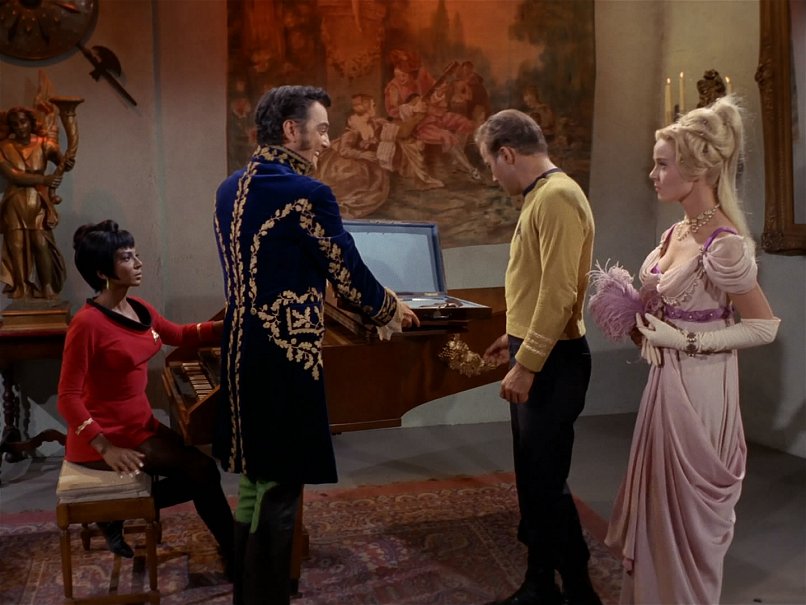
Overview – The Enterprise is passing through a void
in space with very few solar systems en route to the Beta VI colony. When the
ship encounters a rogue planet, Sulu and Kirk disappear from the bridge. As
Spock and the rest of the crew search for their missing shipmates, they
discover them on the planet in the custody of General Trelane, the
self-proclaimed Squire of Gothos. The crew then find themselves at the mercy of
this powerful being who has a great understanding and fascination with ancient
Earth culture.
Score: 7/10 – The Squire of Gothos is a fun romp that
again pits the crew against a being of immense power. Some have since theorized
that Trelane is a juvenile member of the Q-continuum, but this theory has never
been officially substantiated (the novels don’t count). What we do know is that
William Campbell, who will go on to play the Klingon Koloth in the classic
tribbles episode, takes on the role of the Squire with a relish and infectious
energy that makes him an endearing adversary. It is nice to see the crew in the
beginning of the episode work without the captain, giving Spock command of the
ship and he handles it well. The banter between Kirk and Trelane is lively and
clever. The different failings in Trelane’s recreations are logical for the
character. The story meanders a bit as Kirk and crew face and overcome one
Trelane-induced obstacle after another. At one point I felt that Trelane was
acting like an over-indulged spoiled child, and then the reveal at the end of
the episode confirms my sentiments. So while the episode has some weaknesses,
Campbell’s energetic performance makes it an enjoyable one, at least.
Relevance – 2 points. A point is scored for the
salt-monster from “The Man Trap” appearing as one of Trelane’s statue
decorations. McCoy does a great shocked look when he sees the creature again,
establishing that he remembers the near death experience. A second point for
the first appearance of Lt. DeSalle, who will return in “Catspaw” and “This
Side of Paradise”.
Continuity – 2 points. Character continuity works. Of
particular note, I liked how when the banquet was offered to the away team,
McCoy just picked up a plate and started digging in. He is, if nothing else, a
very practical doctor. Kirk also acts the way that we are accustomed to, especially
when he goads Trelane. Story continuity also works out here. Where I will
deduct a point is in the Universe continuity. It is stated that Trelane is
seeing 900 years into Earth’s past, and yet if this is true, then based on the
time era that Trelane is obsessed with, this should be taking place in the 27th
Century, not the 23rd.
Character Development – 1 point. Spock is put in
command of the ship as soon as Kirk is abducted. We see him come up with some
ingenious strategies in getting the away team back. Both he and Kirk match up
against Trelane, with Kirk usually taking the lead. There is not much
significant for either of these two, however, and I wouldn’t say that the
episode really advances anyone’s character much, so this is minor development
at best.
Social Commentary – 1 point. As fun as Trelane
is, what does the Squire of Gothos really teach us? How to deal with a spoiled
brat of a kid with god-like powers? With that, I think Spock gives us something
to consider when he announces to Trelane that he “objects to intellect without
discipline” …” to power without constructive purpose”. Beyond that statement,
it is hard to see how the story gives us anymore insight into that theme. It is
simply Kirk and company trying to outwit the trickster. So apart from a few
statements, there is really nothing that drives the point home. Still, it is a
lot of fun to watch, even if it doesn’t give us much to think about after.
Cool Stuff – 2 points. I have to score a point for
Trelane. He is such an over-the-top character and Campbell plays him with such
zest and energy that it is hard not to like him. I also scored it a point for
the salt-sucking monster from “The Man Trap” making a cameo and scaring the
doodles out of McCoy.
Rank – Lieutenant (15
points). A
very popular episode with a talented guest star in an entertaining role. While
the story has some issues with keeping the pace focused, it is entertaining.
While I suspect that some may want to skip past this episode, I would offer
that while we may not gain some greater insight into the human condition, it is
a good episode in that the story is entertaining. If you want to challenge me
to a duel over it, I await your glove-slap.
If you would like to read other reviews from the Original Series, click on the link here. If you would like to read an episode review from any of the Trek series, click the following link to get to the series catalog. If the episode you want reviewed has not been done yet, then feel free to request it in the comments and I will see what I can do.
For those who are new to my episode reviews, you can find the post where I establish my point criteria here.
Overview – When their last desperate attempt to
stop the Borg fails, Riker and the crew of the Enterprise are forced to make
repairs while Starfleet assembles a fleet to take on the threat. With Picard’s
knowledge assimilated by the Borg, they make short work of the fleet. Riker,
burdened both with the loss of his captain and command of the Enterprise, turns
to Shelby to act as his first officer. Riker devises an unorthodox plan to both
stop the Borg and to save Captain Picard.
Score: 9/10 – Three months was a long time to wait
back in 1990. Amid all the speculation and rumors that were being kicked
around, I remember well the anticipation behind the season premier. I felt that
while the second episode of this arc was not quite as good as the first, it did
not disappoint. There were a lot of interesting decisions made in this episode.
Most notably was the choice to show the aftermath of the Battle of Wolf 359
instead of the actual battle itself. I felt that while the battle would have
been nice to see, not knowing what happened made the revelation that much more
powerful. I also liked how many of the characters were given integral parts in
solving the dilemma. While Riker was the captain, he properly relied on the
expertise of those around him. Beverly is the one who hones in on the Borg’s
interdependency as their main weakness, Data and Worf go on the special mission
to capture Locutus, and Troi is the one who identifies that it is Picard making
his way through the collective to give them the key to their victory. Of
course, we have to get Riker over the loss of Picard and get him to a place
where he can be the leader everyone needs him to be. Enter Guinan, who gives
Riker the right motivation in a brilliantly executed scene that helps us
realize that the only way to both beat and save Picard is to let him go. The
moment that Riker sits in Picard’s chair is defining for the new captain. There
are also some great visuals during the rescue of Picard, and it is nice to see
the saucer separation one last time on the series. There are some great moments
in the telling of the story, and I would like to highlight one of them. When
Locutus/Picard is in the lab and they are trying to use him to get Data in
contact with the Borg collective, at one point Locutus attacks with his
mechanical arm. Then, a few moments later, as Picard is struggling to break the
influence of the collective, he grabs Data’s wrist with his human hand. I found
that a great choice of imagery and symbolism, which adds to the strength of the
episode. Where I gave Part I a 10/10, I have to admit that Part II is a
slightly weaker episode. This does not mean that it is in any way a weak
episode, but after such a strong and near perfect part I, it is difficult to
maintain that level. Where I think the episode could have been a bit stronger
is with the character of Shelby. In part I she was a force to be reckoned with.
In part II, while she was now a cohesive part of the team, her contribution
seemed to have lessened. For being an expert on the Borg, she might have been
in a better position to contribute a lot more, but in the telling of the story
her role seemed to have been sacrificed a bit. The final solution of the
episode is also a bit of a controversy in fan circles. Even Cliff Bole, the
director of the episode, felt that the end was a bit rushed, even going so far
as to call it a cop out. While that may be, I thought that the resolution of
the Borg invasion was appropriately simple. While many may have wanted a big
“blow them up in a huge space battle” type of ending, I liked how it was by
thinking through the problem that they found their way to beat the Borg. Still,
I get why some felt a bit let down by the ending.
Relevance – 3 points. This episode will have a great
impact on the Trek franchise. The Battle of Wolf 359 will be referenced later
in the season in the episode “The Drumhead”, and it will serve as the launching
point for Deep Space Nine’s premier episode. We also have Q elude to these
events in Voyager’s episode “Death Wish” that without Q(uin) saving Riker’s
ancestor, the Borg would have assimilated the Federation. In “Way of the
Warrior”, which was DS9’s Season 4 premier, Worf and O’Brien reminisce over the
events in this episode. This makes this episode one of the most influential and
relevant episodes in Star Trek.
Continuity – 3 points. Riker acts as one would expect.
First, he is uncertain and distraught over almost killing Picard, and
conflicted over failing in his attempt to do so. He then has a great dialogue
with Guinan that finally allows him to both literally and figuratively take
Picard’s seat. He swallows his pride and sees the value in Shelby’s skill set
and makes her his first officer. This is so true to Riker’s character. Universe
continuity also works here. There is one part of the story continuity that
might have some people scratching their heads a bit. When Data is linked to
Locutus in an attempt to access the collective, he is being monitored by Chief
O’Brien. One would assume that with this mission they would need the best
people monitoring Data’s well-being you would want the officer who is most
knowledgeable with Data’s circuitry, and that person is Geordi. However, in
researching this episode, I learned that actor Levar Burton was hospitalized
during the filming of this episode. This limited his availability for filming,
so having O’Brien in this role made sense.
Character Development – 3 points. This is again a
strong Riker-Picard episode. For Riker it’s about his first time in the big
chair as captain. He had to learn how to make some real tough choices (choosing
Shelby as his first officer is one of the main ones). He showcased his
brilliant strategic mind by beating the Borg, even though they had Picard’s
knowledge. He had to learn to lead without having Picard to back him up. His
growth in this episode is significant, and he is a stronger character for it.
Picard’s growth was very different, and we saw it through a very different
lens. As we see his humanity stripped away from him, we are told a story
without hardly any dialogue being used. The scene where we see more of the
transformation of Picard into Locutus is so powerful when we see the single
tear trickle down his face. Picard has been violated in ways that we cannot
imagine and has likely, with this single event, suffered more than any other
character in Trek to this point. It will continue to haunt him for years to
come.
Social Commentary – 3 points. Similar to Part I,
we see some themes of being thrust into the role of leadership. Where before
the idea of Riker’s seemingly stalled career path was the focus, now we are
forced to look at him in the command that has finally come to him. For a while,
Riker refused to sit in the captain’s chair in his ready room, still thinking
that Picard should be there. In comes Guinan, who takes the chair herself to
make a point. Like it or not, Riker, but that is your chair now, and the crew
needs him to sit in it. Through Guinan, Riker has to learn that he must let go
of Picard in order to both defeat and save him. It shows us that we must let go
of the past if we are to move on with the future.
Cool Stuff – 3 points. A point is scored here for the
afore mentioned scene with Guinan and Riker. It is a great moment, almost a
coming-of-age one, for Riker. It works on many levels. Another point is being
scored for the rescue of Picard (or the capture of Locutus, however you want to
see it). It shows some great effects and gives us the most action in the
episode. Best of all, we see the saucer separated from the drive section one
last time on the small screen. Picard’s transformation into Locutus is also
neat to see.
Rank – Admiral (24
points). When
we look at both parts of “The Best of Both Worlds”, it is hard to argue that
Part II did not quite live up to the bar set by Part I, but that is not a
criticism of the episode in itself. While it is a little weaker, it is still a
very strong episode that gives us a great mix of drama, action, and thrills.
Perhaps in today’s standards it might seem that more could have been done, but
again, that does not detract from how wonderful this episode really is. So
while Part II may not pack as strong of a punch as Part I, it is still worthy
of its association. Besides, you cannot watch Part I without having to see how
it ends. This is a must see episode.
If you would like to read other reviews from the Next Generation, click thislink.
If you would like to read an episode review from any of the Trek series, click the following link to get to the series catalog. If the episode you want reviewed has not been done yet, then feel free to request it in the comments and I will see what I can do.