Showing posts with label Julian Bashir. Show all posts

Tuesday, July 3, 2018

Episode Review - The Storyteller (Deep Space Nine, Season 1)

For those who are new to my episode reviews, you can find the post where I establish my point criteria here.


Overview – O’Brien and Bashir travel to Bajor for a medical emergency. The good doctor tries to get on O’Brien’s good side while the chief would rather not have anything to do with him. Upon arriving at the village Chief O’Brien suddenly finds himself as the spiritual leader, replacing the Sirah. In addition to being the spiritual leader, O’Brien is also supposed to protect the village from the Dal’Rok, a mysterious energy being. Meanwhile, back on the station, Jake and Nog befriend a young Bajoran girl who was made the political leader of her village after Cardassians killed her father. As she tries to put forward a strong persona during the negotiations with a rival village, a lovestruck Nog tries to connect with her.


Score: 6/10 – For some people, “The Storyteller” is a great episode, for others it is pointless filler and boring. I find myself somewhere in between the two viewpoints, leaning a little on the good side. The two stories being told are mildly entertaining, and the Dal’Rok is a cool idea. It turns out that it was created by a previous Sirrah of the village as a means to bring about unification and harmony among the citizens. It is a secret passed down from Sirah to Sirah, and the current successor is unprepared to take the mantle upon himself. An unlikely and unwilling Chief O’Brien is chosen instead. It is interesting side-note that O’Brien says he was not sent by the Prophets, but when we learn about Sisko’s Prophet connection throughout the series, it turns out that O’Brien was indeed sent by the prophets. O’Brien is a true fish-out-of-water here, with Bashir cheering him on. On the other side of the episode we have another Jake and Nog adventure to help give the other characters some screen time. This story is a bit less compelling than the main story, although there are some great moments in it. Nog continues to get the people around him in trouble, and the prank with the oatmeal in Odo’s bucket is quite funny.


Relevance – 2 points. This is also the first time that legendary baseball player Buck Bokai is mentioned, so that also gets a point. Most importantly, this episode begins the fun and interesting journey of O’Brien and Bashir on their unlikely friendship. To be honest, at the time of its original airing, I was very much like Miles with respect to Bashir. I found the young doctor to be annoying and self-absorbed. As their relationship developed, I continued to mirror the engineer and his feelings towards Julian. This is the episode where one of Trek’s best friendships starts, and at the time it was difficult to imagine them becoming anything remotely close to friends.


Continuity - 3 points. Story continuity is good. Things flow along nicely, and nothing stands out as contradictory. I also found the character continuity to be good here. O’Brien really disliked Bashir here, and it’s perfectly understandable. I also found his reluctance to be the Sirah to be appropriate. Bashir, of course, finds a way to be oblivious to the Chief’s annoyance and starts to worm his way into O’Brien’s good graces. Universe continuity also works here, though it is a little odd that this one village on Bajor has not drawn any attention with the Dal’Rok over the many years.


Character Development – 3 points. We are definitely going to score points for the beginning of the development between Bashir and O’Brien. As will be said in “The Explorers”, this is the start of when O”Brien starts to not hate Bashir anymore. If for no other reason, this episode should be viewed to see how this 24th Century bromance began. There is also some good development for Jake here. It is minor in comparison to Nog’s, but as is often the case for these two, Jake becomes the voice of balance and reason for Nog’s excitement.


Social Commentary – 2 points. There are a few things here that could be drawn upon. There is the meaning behind the Dal’Rok, which is that nothing unites a bickering group of people like a struggle against a common foe. That message is very much on the direct side of things. There is also the idea of leadership, which goes a little deeper than previous example. In the case of O’Brien, leadership is thrust upon him to inspire the Sirah’s apprentice to rise up to the challenge. In the case of Jake and Nog’s friend Varis Sul, it’s about how to learn to be a leader. Both stories have some distinct parallels. Both involve a leader who feels unprepared for their role. Both are required to step up and find confidence in themselves. In the case of the former apprentice Hovath, his role as Sirah is given to another, while Varis Sul has to emerge from her father’s shadow on her own (with a little guidance from Commander Sisko and encouragement from Jake and Nog). She then comes to terms with the fact that she can compromise and still be seen as a strong leader. Both give us some good insights on what it means to become a leader.


Cool Stuff – 1 point. The Dal’Rok and its story is interesting. While the effects are not necessarily state of the art, they do work and are effective. The idea behind it, as a way of the Bajoran Sirah years ago to unite the village and in doing so eliminating the hatred and distrust that divided them. While the series would eventually outgrow this type of story, it is still a cool one.


Rank – Captain (17 points). While this episode is in the mediocre-at-best category by itself, it is still a good story due largely to the beginning of really nice friendship. Of all the relationships that the various characters find themselves in, the one between O’Brien and Bashir is cited as being one of the most authentic. These two seem to be polar opposites, and they have a really rough start of it, but this is the episode where it really all starts. For that reason alone, I would suggest you give this episode a viewing.


If you would like to read other reviews from Star Trek: Deep Space Nine, please click the following link.


If you would like to read an episode review from any of the Trek series, click the following link to get to the series catalog. If the episode you want reviewed has not been done yet, then feel free to request it in the comments and I will see what I can do.


Monday, February 5, 2018

Episode Review - Crossover (Deep Space Nine, Season 2)

For those who are new to my episode reviews, you can find the post where I establish my point criteria here


Overview – Kira and Bashir are returning from opening a hospital on the New Bajor colony in the Gamma Quadrant. As they enter the wormhole, something happens with their warp field that sends them to a parallel universe where Klingons and Cardassians are allies and humans are slaves. Learning that this is the same universe that legendary Starfleet Captain James T. Kirk once visited, they find themselves in a power struggle where familiar faces are not the people they knew in their universe. Kira and Bashir try to find a way back to their universe before they are killed (or worse).


Score: 9/10 – Ah, the Mirror Universe, where all bets are off. “Mirror, Mirror” is one of the best Original Series episode, and we fans finally get to see how Kirk’s influence on Spock is resolved. Sadly, it looks as if Kirk royally messed things up for the Terran Empire almost a century ago. Spock’s new empire was weak and soon fell victim to the combined Klingon-Cardassian alliance that is now the main enemy in this alternate universe. This episode is the first of five episodes in Deep Space Nine that are set in this universe originally established in the Original Series, and will be revisited in both Enterprise and Discovery. One of the strengths of this episode is that the counterpart characters are so delightful to see. While there is little difference in O’Brien (or “Smiley”, as the mirror Ben Sisko calls him), Garak is far more treacherous and sadistic, Odo is a ruthless villain, Sisko a care-free collaborator, Kira a seductive and twisted tyrant, and Quark a lowly bartender who tries to help out the humans out of a sense of decency instead of profit. The other fun aspect of this episode is that all bets are off with these counterpart characters. Odo and Quark are both killed, the former is a bit of an explosive manner, the latter off screen. This basically means that nobody (outside our crewmen from our universe) is safe, which really frees up the story telling. There is also a good dose of humor at the beginning of the episode as Bashir tries to charm his way into Kira’s graces. Once they enter into the mirror universe, however, the levity is appropriately finished and things get really serious very quickly. A great piece of Star Trek television.


Relevance - 3 points. So there is the obvious connection to the Original series episode “Mirror, Mirror”, plus the four mirror universe episodes that follow in DS9. Add to that the great two-part story from Enterprise and the significant plot points in Discovery’s first season, and you have a solid reason for knowing and watching this episode. There are also some other important references. Kira and Bashir are returning from establishing a hospital on a new Bajoran colony in the Gamma Quadrant. In the season finale episode “The Jem’Hadar” it will be revealed that the Dominion massacred this colony. Overall, a very relevant episode for the franchise.


Continuity – 3 points. Story continuity works out well here. While the Intendant Kira knows that Bashir and Kira need to die (according to Alliance law), her reasons for keeping them alive make sense and advance the story. Universe and character continuity are a bit trickier here, as this is a different universe playing by its own rules. Suffice it to say, there is not anything in the mirror universe that doesn’t make sense. It was a logical progression of how the universe came to be where it was in DS9 from what we saw in the original series. For what we did see of our own characters (not the MU counterparts), everyone was acting as they should. What was fun was seeing how our universe people compare to their MU versions.


Character Development – 3 points. Definitely a Kira and Bashir episode, both characters go through some significant growth. A lot of it is established in the opening teaser scene where Bashir is trying to get the Major to warm up to him, just like he supposedly did with Chief O’Brien (while, contrary to the good Doctor’s opinion, the chief and him weren’t close yet, but they eventually become the best of friends). As he tries to get her to call him Julian, we see how Kira is still more annoyed with him. Then they end up in a struggle for survival. Bashir grows up here a lot as he is taken out of his comfort zone, while in the meantime Kira is faced with a much different situation. She faces who she could have been if things had turned out differently, and it is clear that she doesn’t like it. Nobody likes to face their evil twin. When the story ends, it seems as if Kira has come to a new-found respect for Bashir.


Social Commentary – 2 points. I often find that with really exciting episodes it is harder to find much to score in this section. As I thought about “Crossover”, there were a couple things that we could take from this. First, there is always something to be said about confronting your dark side, which is what Kira does here. That’s good for a couple points, at least.


Cool Stuff – 2 points. Where to start, where to start. Well, we’re in the MIRROR UNIVERSE! That is cool in itself, to see how everything and everyone turned out after Kirk and company visited there about a century before. Of particular note is Quark, who is likely the most different in the MU than here. To see him as being the only decent person who is willing to help others with no thought to himself is fun. Also, I am giving a point for the cool effect of watching mirror Odo get obliterated by Bashir.

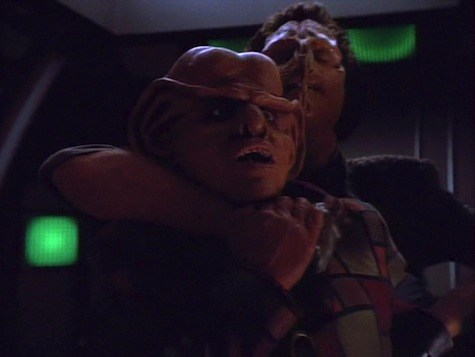
Exploding Odo


Rank – Admiral (22 points). This is definitely a highlight for the second season of DS9. It is exciting, fun, and dark. We pick up where a classic Original Trek episode left off and sets up a whole bunch of future episodes. Best of all, it’s a well-made episode.


If you would like to read other reviews from Star Trek: Deep Space Nine, please click the following link.


If you would like to read an episode review from any of the Trek series, click the following link to get to the series catalog. If the episode you want reviewed has not been done yet, then feel free to request it in the comments and I will see what I can do.

Don't like the Mirror Universe?

Friday, November 17, 2017

Episode Review – The Quickening (Deep Space Nine, Season 4)

For those who are new to my episode reviews, you can find the post where I establish my point criteria here


Overview – Bashir and Dax find themselves on a planet in the Gamma Quadrant where the inhabitants are suffering from a deadly plague engineered by the Dominion. Bashir accepts the challenge of curing the disease, which he soon learns is much more difficult than he originally anticipated. As he races against the odds, he learns more about his own limitations than anything else.


Score: 8/10 – Bashir finally gets knocked down a few pegs in this episode (directed by Rene Auberjonois). No matter what he does, the people on this planet are dying and Bashir cannot seem to save them. This episode starts off with a lot of humor as the main characters deal with Quark’s attempt to include merchandising and advertising for his bar (I dare you to not think of the jingle for Quark’s when reading this). It is one of my favourite funny scenes in all of Star Trek, and it gives us a good laugh that we will sorely need, as the story quickly falls down a dark hole with little hope and relief until the end. Bashir, who is used to being able to do whatever he sets his mind to, gets a strong dose of reality when he comes across a disease that he cannot cure. Indeed, even in the solution he finds it is only a vaccine for the next generation and does not do anything for those already infected by the disease. It is a powerful and tragic tale that leaves us on a bit of a bittersweet ending. Alexander Siddig shines in this episode. With the exception of Dax and Kira (to a far lesser extent), Bashir is the show. Everyone else on the cast is either in the humorous opening scene or the somberly reflective closing scene.


Relevance – 2 points. Tal Shiar chairman Koval will question Julian about this incident in the seventh season. That scores a point here. The opening scene follows up on Quark’s desire to produce merchandising, something he brings up with Sisko in the final episode of the second season “The Jem’Hadar”. That’s enough for a second point.


Continuity – 3 points. No problems with any part of continuity. The plague is a devilish insight to the resources and resolve of the Dominion. The characters respond exactly as we would think they would. While Bashir arrogantly swoops in, thinking that he will save this people from doom, he learns his own limitations. Dax, meanwhile, offers realistic support, blending compassion and hope with realism and logic. Story wise, all goes as it should and tells us a heart-breaking tale of failure and bittersweet hope for the future.


Character Development – 2 points. Bashir gets all the attention, and as I mentioned earlier, it humbles the brilliant doctor like nothing else has to this point. He discovers his own arrogance and hubris when he discovers that the Dominion beat him with their genetically engineered plague. When the hope dies with the people he is desperate to save, he stubbornly moves forward. At this point, hopes of being the knight in shining armor are gone, and he just cannot give up until he has tried all he can. Since so much focus is on him, there is really little room for anyone else to receive development, and so be it. While it does not score a full 3 point in this section, it is a fantastic insight into the character of Doctor Bashir that, for me at least, takes one of the largest and most necessary steps into making this character more real. In doing so, it pushes Bashir farther towards the beloved character he would ultimately become.


Social Commentary – 3 points. I suppose this is Bashir’s version of the Kobayashi Maru scenario. No matter what Bashir does, he is unable to cure the people. Instead, he must settle for vaccinating the unborn and thereby saving the society in the long run. As he faces his own limitations, we learn that how we face our own weaknesses is often more important than the outcomes. Sometimes we have to strip away our pride and accept whatever meager positives we can muster. It is not a pleasant experience, but it is one that we all must face. After the trial is over, we regroup and move forward, taking what we have learned, and grow from the failures.


Cool Stuff – 2 points. A point is scored for the fun opening sequence. As I said before, it is one of the funniest Trek moments and is very necessary for the much darker tone of the following acts. I also scored a point for the insidious disease that the Dominion released upon the poor Teplan people. Meant to mirror the AIDS epidemic, the disease more than adequately conveys the despair found in these difficult to control diseases.


Rank – Captain (20 points). Such a somber and telling story. Auberjonois did a fantastic job of directing this episode, and Siddig shines brighter than he ever has up to this point as Doctor Bashir. The sadness at the situation of the Teplan people is authentic, and this is definitely not a “feel-good” episode. The bittersweet ending is a sad reminder of our own limitations, and that the good guys don’t always get the win that we think they should. Definitely give this episode a viewing. Bring some tissues.


If you would like to read other reviews from Star Trek: Deep Space Nine, please click the following link.

If you would like to read an episode review from any of the Trek series, click the following link to get to the series catalog. If the episode you want reviewed has not been done yet, then feel free to request it in the comments and I will see what I can do.

Friday, October 6, 2017

Episode Review - Melora (Deep Space Nine, Season 2)

For those who are new to my episode reviews, you can find the post where I establish my point criteria here.


Overview – Ensign Melora Pazlar, an Elaysian science officer, has been assigned to Deep Space Nine for some research missions in the Gamma Quadrant. Due to her physiology from coming from a world with lower than normal gravity, she requires a motorized chair to move around the station. The crew quickly learn that adapting to Ensign Melora entails more than meeting her physical needs, but her emotional needs as well. Doctor Bashir, in particular, finds himself drawn to her and a special bond between the two of them develops as he discovers a way that she will be able to walk as the others on the station can walk. The treatment, however, comes with a price. Meanwhile, Quark is reunited with a former business associate who has come to the station seeking retribution against the Ferengi bar owner. His price: Quark’s life. The two stories connect and the crew must try to protect Melora, Dax, and Quark from this violent criminal.


Score: 6/10 – I appreciate what this episode tries to do in bringing the struggles of the physically handicapped to light. To have an officer who is physically limited due to the natural conditions of her home world being in conflict with most other places was a unique way of depicting this issue, and is classic Star Trek. The story does a fair job, largely due to one of the writers being confined to a wheel chair himself. Some of the parts of the episode dip into the cliché well a bit (such as the handicapped person getting into trouble trying to make it on their own, learning to accept help from others), but not in ways that are too overbearing or take away from the story. Where this episode suffers is in some of the acting and/or directorial choices. First, there’s Fallit Kot. He is quite an interesting looking alien, and has the look of a tough-as-nails ex-con. He has every reason to want to kill Quark, and yet he comes across as…well, bored. There is little passion or emotion in his lines that convinces me that he is a serious threat. Second, when Fallit shoots Melora in the runabout, Bashir and the rest of the crew are watching the events unfold. Bashir has just started a romantic relationship with Melora, and his reaction to her being shot and presumably killed is severely understated. I found it difficult to believe that he would have stayed so calm. Not a good choice of action for the character. My final complaint with the episode overall is that once the episode is done, that’s it. No follow up, not even a hint that the episode happened. Maybe I missed it, but all the ramps that O’Brien and his crews spent hours on installing are gone by the next episode. This could have had a more lasting and inclusive impact, but once the last scene was completed it was back to normal.


Relevance – 1 point. A point is scored for the Klingon restaurant, which will be seen again in a later episode “Playing God”. Sadly, these are the only two episodes that we will see the highly entertaining Klingon chef, but the restaurant will be referenced in dialogue a few more times. His argument with Melora (revealing not only her iron will but her fluency in Klingon) is a lot of fun.


Continuity – 1 point. Universe continuity works here, so a point is awarded for it. I am deducting points for character and story continuity here, both for reasons I eluded to earlier. Bashir reactions to Melora’s apparent death are just not what I came to expect from him. He is as emotional as they come. He throws himself into his relationships with gusto and zeal. I am not saying he should have curled up in a little ball of whimpering under his console, but I really expected him to have been a bit more animated. Story continuity is the fact that if the crew had spent all this time installing ramps to have made the station a little more accessible to Melora, and it didn’t appear that they would have hampered anyone else, why spend the time and resources in removing the ramps. It just gave this episode a “one and done” feeling.


Character Development – 2 points. This is definitely a Bashir episode where he finally gets lucky in love. After pining for Jadzia for a year it’s nice to see the good doctor get some success in this department. We see how me uses his medical brilliance to help those he loves, but we also see how idealistic he can be. When he offers her the treatment that will allow Melora to walk in normal gravity as everyone else, he is almost oblivious to the notion that she may not want to give up being who she is. We also get some funny moments with Quark and Odo, with Quark needing Odo’s protection from Fallit and Odo (albeit reluctantly) agreeing to do what he is allowed to do by law. Sisko shows how he handles a character like Melora when he denies her request to go on her mission unaccompanied. He balances compassion and understanding with truly treating others like everyone else by telling her that in no situation would he send a junior officer alone on a mission.


Social Commentary – 3 points. How do we own our limitations? While there is the obvious nod towards those who have very visible handicaps, it also applies to most, if not all, of us. We all have things that can hold us back. It may be something that is mental, physical, emotional, or even just as simple as our basic mortality. We have limits of one kind or another. The true strength is in our ability to own those limits and allow us to define them rather than it being the other way around. The character of Melora goes through the standard path that many characters with physical handicaps do. She fights for trust and then has to learn to trust others in return. She and Bashir have some great conversations that anyone can glean inspiration from. I particularly liked the exchange where Melora says she just wants others to know they can count on her, and Bashir counters with asking if she knows that she can count on them. Proving oneself doesn’t mean we won’t ever need someone else’s help, but it does mean that we are capable of assisting others.


Cool Stuff – 2 points. Melora as a character is pretty cool, and in the vein of characters such as Geordi La Forge, a character being confined to a wheel chair is a good step for Trek, even if it was only for a single episode. I also liked the scene of her and Bashir in the low gravity environment and seeing her float with ease. That scores a point. The second point is for the make-up of Fallit Kot, especially the nose piece that connects to his chin. While I felt that the character was lacking in how he was portrayed, I really liked the look.


Rank – Lieutenant (15 points). While not necessarily a bad episode, there are a few let downs. I really think that in spite of a well-intentioned and good effort, there were some missteps in character direction that cost the overall show. Still, it gives us a good message and has some good moments. So while you may be fine missing this episode while going through the series I would suggest that you catch it at least once. If nothing else, the Klingon chef gives us some soothing dinner music.


If you would like to read other reviews from Star Trek: Deep Space Nine, please click the following link.


If you would like to read an episode review from any of the Trek series, click the following link to get to the series catalog. If the episode you want reviewed has not been done yet, then feel free to request it in the comments and I will see what I can do.


Monday, August 7, 2017

Episode Review - Armageddon Game (Deep Space Nine, Season 2)

For those who are new to my episode reviews, you can find the post where I establish my point criteria here.


Overview – Doctor Bashir and Chief O’Brien are on T’Lani Prime, assisting in the destruction of the Harvesters, a deadly biochemical weapon. As they work with scientists on both sides of a deadly war, Kellerun soldiers appear and start killing everyone. O’Brien and Bashir escape and are now hunted men. Meanwhile, back on the station, Sisko is informed by the ambassadors of the two sides that Bashir and O’Brien are dead following an unfortunate accident. Keiko, upon viewing the data recording of the incident, finds her husband’s actions a bit hard to believe, and soon has Sisko looking for answers.


Score: 7/10 – This is a fairly good episode from DS9’s second season. It has some suspense as O’Brien and Bashir go on the run. Miles being infected by the Harvesters adds to the tension, and the two are forced to work together to survive the ordeal. While the writers try to add to the tension with this standard plot device (incapacitate one character so they have to rely on each other to survive), the audience knows full well that neither of these main characters is going to die. Still, it is fun watching them bicker, open up to each other, and eventually trust each other. This episode, while not the first time these two characters have been paired together (that happened in the previous season’s “Storyteller” as well as racquetball combatants in the earlier episode “Rivals”), it is considered to be the beginning of the friendship that will develop between the two and become very significant over the rest of the series. There is some action, intrigue, and a few plot twists. While the storyline is fairly generic (really, you could have made an almost infinite number of stories by pairing up any two random characters), it works because O’Brien and Bashir have such great chemistry. The relationship that is started here will become one of the most realistic friendships in the franchise. There are also some nice plot twists near the end, with the final one being delivered in the closing seconds. Keiko, when she was informed of her husband’s apparent death, found that her husband was drinking coffee in the afternoon. She insists that he would never drink coffee this late in the day, and insists that the recording she saw must be a fake. This is what starts the rest of the crew on the road to rescuing O’Brien. It turns out, in the end, that Keiko was completely wrong about her husband (he does drink coffee in the afternoon), showing us that the day was saved because Keiko didn’t know her husband as well as she thought she did. Some fans love that twist, others hate it, but it definitely leaves its mark.


Relevance – 1 point. As I mentioned above, this is where the O’Brien-Bashir friendship truly begins. In previous episodes where they are paired up, it is either as rivals or in a situation that really doesn’t give them a reason to set aside differences. If you are a fan of this friendship, then you need to see this episode to watch how it all began.


Continuity – 3 points. Character continuity is always at risk when you do a story like this. People want a believable reason for two characters as different as the engineer and the doctor to get along, and the writers pull it off. Story wise everything checks out. A point is scored for universe continuity as well.


Character Development – 3 points. Definitely some big things start with the pairing of Miles and Julian. Before this episode, Miles really couldn’t stand the young, cocky doctor. It is understandable as the two have very different personalities. Then, as the story unfolds, the two starts to put aside their differences and must work together. O’Brien really shines initially as the action begins, using his military background to save himself and the good doctor. Clearly in the emergency, Bashir is out of his element. Bashir also gets some great growth, including even more respect for O’Brien. He opens up about himself and his past. Mostly, this episode does a fine job of contrasting these two. O’Brien is the realist, down-to-Earth family man, while Bashir is the starry-eyed, naïve dreamer who loves the freedom in his single status. It gives us exactly what we want from these two. We also have some good moments as the rest of the crew grieve the loss of their friends and colleagues. Most notable is Quark, who in his brief appearance adds more heart to his character than in almost the entire first two seasons combined. As only a Ferengi could, he honors his two cherished customers who always paid their bills.


Social Commentary – 2 points. Working together with someone who is totally different from you often leads to a sense of respect. Unlike other encounters between the two, O’Brien ends this episode with a newfound respect for Bashir. While such situations may not always lead to a fast friendship, this episode shows that it can.


Cool Stuff – 0 points. This is where this episode comes up a bit short for me. There are many good things about this episode, but try as I might, I just can’t think of anything that is really “cool”. The aliens look fairly run-of-the-mill for Star Trek at the time, the sets are standard, and the storyline is routine.


Rank – Captain (16 points). This is an enjoyable episode. Great writing and acting by Colm Meaney and Alexander Siddig take an otherwise typical storyline and make it a fun episode. This is a must see for Season 2.


If you would like to read other reviews from Star Trek: Deep Space Nine, please click the following link.

If you would like to read an episode review from any of the Trek series, click the following link to get to the series catalog. If the episode you want reviewed has not been done yet, then feel free to request it in the comments and I will see what I can do.