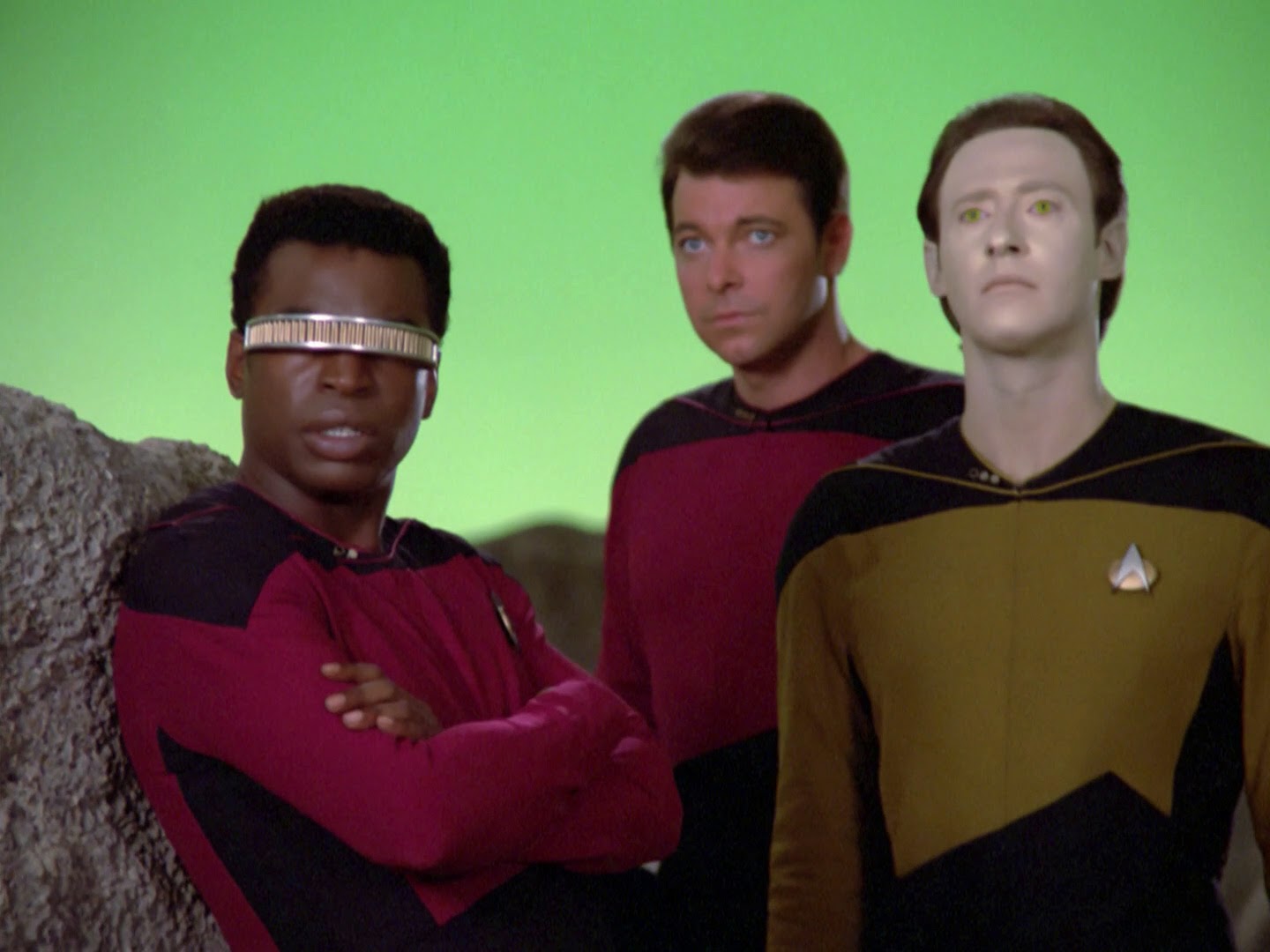
Showing posts with label Star Trek the Next Generation. Show all posts

Wednesday, July 14, 2021

Episode Review – Code of Honor (Next Generation, Season 2)

 For those who are new to my episode reviews, you can find the post where I establish my point criteria here.


Overview – The Enterprise arrives at Ligon II to negotiate a treaty with the Ligonians. They hope to obtain a rare vaccine that is only found on this planet. After meeting with Lutan, the leader of this proud people, he becomes enamoured with Picard’s chief of security, Tasha Yar. Lutan abducts Yar, and makes known his intentions to marry Yar, which draws the ire of his current wife Yareena. She challenges Yar to a fight to the death.


Score: 1/10 – Ah, “Code of Honor”, likely one of the worst episodes of all of Star Trek. It is one of the few episodes where almost every person involved in it, including the cast, felt it was anywhere from embarrassing to sub-par to, as Johnathan Frakes so delicately put it, “a racist piece of s@#*”. The story is fairly straight forward in itself, but the way it was pulled off just does not sit well. The Ligonians were cast by entirely black actors and were made to heavily resemble the stereotypical African tribesmen. There is also a heavy dose of sexism as the women of Ligon II are treated like objects by some of the men, especially Lutan. Add to that a script that is clunky and characters that are so brand new (depending on where you were in the world, this was either the first or second episode to be released after “Encounter at Farpoint”) that the actors were largely still trying to find themselves, and you have a very awkward episode. There are some elements of the episode that were not bad (the fight sequence between Yareena and Yar was fairly intense at times) and the score is very well done, but the weaknesses of the episode were largely responsible for the collective bad taste left behind after viewing.


Relevance – 1 point. Very little that is established here is actually relevant later on in the series. Data’s attempts to understand humor is brought up multiple times before and since, so his continuation of that here does not seem to be very relevant. Having said that, there is one point for relevance that I can give this episode. Wesley mans a bridge console for the first time, as he is asked by Picard to man Ops for a while, and at the end of the episode the good captain suggests that young Wesley will have other opportunities in the future.


Continuity - 1 point. Character continuity takes a hit. Yar accuses Troi of tricking her into admitting that she has some base attraction towards Lutan. First of all, I really find the whole sequence to be forced, and Yar describes Troi as her friend. To be honest, there is little that has been established to suggest that the two are friends. Colleagues and crewmates, yes, but friends? Not so much. I think that line could have been better written. I also found it hard to believe that Yar needed to know she had a base physical attraction. I am surprised that she found herself attracted to Lutan at all, as his sexist attitude would completely turn off a woman of Yar’s mettle. I found the story continuity a bit lacking. They talk about this vaccine that will save millions of lives with more people becoming infected as the episode progresses. So why is the Enterprise only receiving reports on the number of people contracting the Anchilles fever? Surely if the plague is as serious as it is portrayed to be they would be receiving casualty reports that include deaths. Sorry, there are too many plot holes to keep the point here. Universe continuity, on the other hand, does appear to be intact here, so not a total waste.


Character Development – 1 point. This is one of the very few Yar-centered episodes, and yet her character does not move along or progress here. She is the same at the end as she was at the beginning. In the previous episode “The Naked Now” we learn far more about her and see so many different sides of her. In this episode, she is a good little soldier who wins a fight while being the object of lust by a tribal lord. However, I do give a point for Wesley’s development. This ties in with the section on Relevance, but the fact that he is allowed to man a bridge station is a big step forward for him and his relationship with Picard, so that should be noted.


Social Commentary – 0 points. I keep scratching my head here and I really cannot think of anything truly meaningful here. Maybe this is my bias against the episode talking, but what do we really learn? To fake a death to trick a misogynistic culture? Admit when you are attracted to a misogynistic tyrant? No, there is really nothing here about societal commentary that I can identify in this episode. If anything, this episode serves as a reminder that we must be diligent in not allowing crude, sexist, and racial stereotypes to be shown.


Cool Stuff – 0 points. Nothing stands out as “cool” in this episode. When I look at the parts that weren’t bad or offensive, such as the battle between Yar and Yareena, I must admit that not being bad isn’t enough to be considered as excellent or cool. So no points for this section either.


Rank – Crewman (4 points). The first season of any show is bound to have some missteps as writers, actors, and producers are all trying to find their footing. Here is a big one for TNG. I will say that there is a historical reason to watch this episode, though. Garrett Wang, who would go on to play Ensign Harry Kim in Star Trek: Voyager, has said that this was the first episode of TNG that he ever saw. He hated it so much that he chose not to watch any others. A few years later he thought he would give the show another chance and found it on TV. It was this episode again, so he wrote off the entire show. When he went to audition for Voyager, he had no real connection to Star Trek, even though he was a big sci-fi fan. It was after getting cast that he started to watch TNG and DS9 and became a fan of the shows. He has admitted that if he had been such a fan before the audition, he likely would have been really nervous and would have blown the audition. So, I guess that redeems “Code of Honor” to an extent. Right?


 If you would like to read other reviews from the Next Generation, click this link.


If you would like to read an episode review from any of the Trek series, click the following link to get to the series catalog. If the episode you want reviewed has not been done yet, then feel free to request it in the comments and I will see what I can do. 

Tuesday, January 28, 2020

Episode Review - The Host (Next Generation, Season 4)


For those who are new to my episode reviews, you can find the post where I establish my point criteria here.


Episode Review – The Host (Next Generation, Season 4)
Overview – Doctor Crusher has fallen in love with Odan, a Trill ambassador who is being sent to Peliar Zel to mediate a dispute between inhabitants of two of its moons. Unbeknown to anyone on the Enterprise, Odan is a joined Trill who possesses a symbiont that makes the true character of Odan. When Odan is injured in an attack by a radical faction, the true nature of the host and symbiont is revealed. Because the host body is dying, a new host must be found. Riker volunteers to serve as the new host, and when Odan is transplanted to him, he still professes feelings for Beverly. As the negotiations continue, Riker/Odan struggles with the new arrangement and Beverly wrestles with the conflicting feelings for her lover who now inhabits the body of her friend.


Score: 7/10 – “The Host” introduces us to the Trill, a species that will become important to Deep Space Nine in a few years. The Trill are very different from what they will be when we meet Jadzia Dax, but more on that later. What this story is about is the concept of love surviving a great and significant change. Does Beverly love the soul that is Odan, or is it that which is on the outside as important as what is in the inside? It is nice to give Doctor Crusher a romance (although in the real-life story of filming of the episode, it is interesting that her first love story came when the actress was in the late stages of a real-life pregnancy), and the idea of changing the outer appearance of her partner to someone who she has a great romance with is refreshing. The ending gives us yet another twist as the new host to take on the Odan symbiont is female, which proves to be too much of a change for Beverly. The basic story is fairly routine and more character-driven than anything else. There is a little bit of action, and it is interesting to see Riker and Crusher in a romantic situation. Overall, a good, but not great, episode.


Relevance – 1 point. Pretty much the only part of this episode that is relevant to the franchise as a whole is the introduction of the Trill. As a species that is symbiotic, it is quite interesting to see its origins, even though by the time we next see them they will be very different in look and details.


Continuity – 1 point. Character continuity is good here. We have never seen Beverly involved romantically before, but this one really puts her through some rigors. She is understandably conflicted when she is faced with her lover inhabiting Riker’s body. For story continuity and universe continuity, I am sadly forced to deduct their points. I get that when a show creates a new alien species, it may undergo some great changes if and when the producers decide to further develop them. If this was the only time that we see the Trill, things would have been different. However, that is not the case. For story continuity, there is the issue of nobody on the Enterprise (and presumably the Federation) knowing about the true symbiotic nature of the Trill. In DS9, however, we know that Benjamin Sisko knew about it from his association with Curzon Dax. Universe continuity takes a hit with a change in the outward appearance of the Trill, from forehead ridges to spots. I get that the species will change as the producers go from a one-and-done alien of the week to a central character, but there is little in common with the physical appearance of the host bodies. There is also the idea that the Trill is mix of the host and symbiont, being highlighted in the different personalities of Jadzia and Ezri Dax. In this episode, the symbiont seems to have full control. Riker, as the host, is still fully Odan, not a mix of Odan and Riker. I debated where to deduct this point, seeing as how in the pilot episode for DS9 is where we see the changes. I chose to deduct from this episode as it is the only time we see Trill like this, and the Trill story in DS9 as a series is consistent.


Character Development – 2 points. While Riker does get a bit of attention here, it is mostly in the fact that he volunteers to become the temporary host for Odan. Everything he does after that is Odan, not Riker. For Beverly, it is about time that she gets some romance in her life. Again, it is funny that it happens when actress Gates McFadden is feeling the absolutely least romantic with her being in the final trimester of her pregnancy. One aspect about Crusher here that has created a bit of controversy is that she rejects Odan when the symbiont is transferred to a female host. I’ll talk about that more in the Social Commentary section, but for now it suffices me to say that she shows us that there is a limit as to what she can accept in the appearance of her lover. The most significant part of this revelation is that she is completely honest about it. She does not make excuses for it nor does she try to rationalize it. She simply accepts her limitations.


Social Commentary – 2 points. Many fans criticized this episode for having a homophobic theme to it. They feel that Crusher should have accepted Odan in her female host, and the fact that she couldn’t shows intolerance and homophobia. I would disagree with that opinion. This is not homophobia, but it should be seen as being true to oneself. Let me take the criticism from a different perspective. According to the detractors Beverly should have been willing to develop romantic feelings with Odan regardless of Odan’s outward appearance. By that logic, everyone should be pansexual, falling in love with the soul regardless of the gender of the love interest. Should a person who is homosexual be expected to be attracted to someone of the opposite gender if they are attracted to the soul of the person? Some would say that in doing so it denies who they are. So why would the same not be true of those with a heterosexual orientation? Beverly Crusher is heterosexual. She admits that maybe at some time in the future people will not have those limitations, but I think that for the time being, we have to accept that for most of us there is no denying that the outward appearance does play a part in our romantic attractions. Perhaps the most important aspect of this lesson is that we should be honest with our feelings. It’s not a perfect commentary, but our world is not perfect. Facing those imperfections is the first step in overcoming them.


Cool Stuff – 1 point. A point scored for the concept of a symbiotic sentient species. The Trill is a great addition to the Star Trek pantheon. The look of the symbiont, which was one aspect that did not change too much, is quite different and at the time was quite cool.


Rank – Lieutenant (14 points). “The Host” is a good showcase of Beverly Crusher that introduces a soon to be significant alien species in the franchise. Having said that, DS9 develops the Trill far more than this episode does, and in doing so makes some significant changes that were established in this episode. Doctor Crusher fans will not want to miss this episode, while those who find canon discrepancies to be infuriating may want to avoid it. If you do miss this episode, you will miss out on an above-average episode, which might be OK. I enjoyed it, but I get how others might take issue with the abrupt changes between now and DS9.


If you would like to read other reviews from the Next Generation, click this link.


If you would like to read an episode review from any of the Trek series, click the following link to get to the series catalog. If the episode you want reviewed has not been done yet, then feel free to request it in the comments and I will see what I can do. 


Monday, March 11, 2019

Episode Review - The Masterpiece Society (Next Generation, Season 5)


For those who are new to my episode reviews, you can find the post where I establish my point criteria here.


Overview – The Enterprise is observing a stellar core fragment and discover that it is about to collide with an inhabited planet populated with genetically-engineered humans. As Picard and his crew discuss ways to save the colony, Deanna Troi forms a romantic relationship with one of their leaders, Aaron Connor. When the crisis is averted, the crew learn that their presence has caused unintentionally another problem among this “perfect” society.


Score: 4/10 – Oh Troi, why can’t the writers find a good romance story for you? “The Masterpiece Society” does try to give our beloved counsellor some attention in the romance department, but the spark and chemistry just do not seem to work here. The character of Aaron Connor is a tad on the dull side, and other than being physically attractive, I am not sure why Troi falls for the guy. The colony of genetically-engineered humans are just a bit too perfect, and they are not very interesting. The story moves along slowly, and it is only when the core fragment issue is dealt with that the interest begins to pick up. Hannah Bates (the first of three Trek roles for actress Dey Young) is sympathetic enough, and Ron Canada (also making his first of three Trek characters) is effective as Martin Benbeck, the representative of keeping the status quo. Even though these two characters are effective, they are unable to bring a lot of interest into the colonists. There are some good points, such as Picard’s debate with Connor, but you have to slog through a lot of boredom to get there.


Relevance – 0 points. This is one of those episodes where they do refer to some things that are recurring themes in Star Trek, mainly the thoughts towards genetically engineered humans. While this is a recurring theme throughout Star Trek, the events surrounding this episode are self-contained. We hear Picard and Connor banter the concept back and forth, but no mention of specific examples are given. In essence one can skip this episode and not miss anything relevant to the overall discussion of this theme, so it adds nothing.


Continuity – 3 points. Character continuity is intact here, although I was wondering about the likelihood of Troi falling for Connor. She seems to fall for the most unlikely men as apart from being physically attractive, there doesn’t seem to be anything that gives her a reason to fall for him. When I look at her track record, however, I think it fits her pattern. I particularly enjoyed Geordi in this episode, as he gets rightfully defensive about the colony’s attitude towards people with physical imperfections. His glee at the fact that his VISOR technology provides the key to saving them is appropriate. Story continuity does make it, though again I found the relationship between Troi and Connor to be a bit forced. I will also concede a point for universe continuity.


Character Development – 2 points. Troi is the focus, but this relationship does little to advance her character. Geordi also gets some good moments, but nothing that really helps discover things that we didn’t already know. It’s enough to score a couple points here, but that is about it. Again, if you miss this episode, you do not miss much.


Social Commentary – 1 point. The quest for perfection is shown in this colony (well, at least on paper; they really didn’t come across as anything but regular humans). There is also the idea that interaction with cultures external to your own can have unexpected influences. In all there were twenty-three colonists who wanted to leave the colony, creating a large disruption among those who remained. Still, how this concept was discussed really didn’t leave much for the viewer to sink their teeth into, so only a single point can be scored here.


Cool Stuff – 0 points. A dull episode where the most interesting guest characters are foils to a very bland character. John Snyder, who plays Aaron, has a much more interesting character in his first Trek appearance as the Romulan Bochra. I don’t lay blame on the actor for this. I think the character was very one-dimensional and bland, and even the most talented actors are limited in what they can do with a role such as this.


Rank – Ensign (10 points). This is a bit of a turkey episode from TNG’s fifth season. It really does not do enough to make you care about anything until almost the end of the episode. There are some good points to it, so do not give it too much of hard time, but if you choose to skip it, I won’t judge you poorly because of it.


If you would like to read other reviews from the Next Generation, click this link.


If you would like to read an episode review from any of the Trek series, click the following link to get to the series catalog. If the episode you want reviewed has not been done yet, then feel free to request it in the comments and I will see what I can do. 


Friday, September 7, 2018

Episode Review - Hide and Q (Next Generation, Season 1)

For those who are new to my episode reviews, you can find the post where I establish my point criteria here


Overview – While Picard and his crew are traveling to a Federation colony to provide medical assistance, Q returns to the Enterprise. This time the omnipotent being comes with an invitation for none other than Commander Riker. Q is offering him a chance to join the Continuum and inherit all the powers of the Q. Riker is sorely tempted by the offer even to the point where he is able to give his friends and crewmates gifts beyond their wildest dreams.


Score: 6/10 – I always enjoyed the character of Q. He started out as a villain and over time evolved into a pseudo-ally of Picard. This being the second of his episodes, he is still largely seen as the antagonist. He continues his ploys and shenanigans as this time he focuses on Riker. This seems to be the only time that a Q story pairs up our imp of the galaxy with the first officer. Considering the context of this episode, it made sense to try to pass Q around a little to see how his chemistry works with others. This episode shows why this was the only real time that Q and Riker ever got some quality time together. We will learn that Data, Worf, and definitely Picard were better matches, but Riker does OK here. The idea is solid, and we get to see some fun things. Worf dies for the first time, and the haters of Wesley’s character get a bit of glee when they see him get skewered by one of Q’s animal/soldier things. Still, while this is a pretty decent episode, it is by far not the strongest of Q’s stories. His character is pretty two-dimensional, even compared to “Encounter at Farpoint”. Almost every other episode with Q is better, but this one does have some good moments making it worth a viewing.


Relevance – 1 point. A point will be scored for Riker being offered the powers of Q, something that is referred to in the next Q-centered episode “Q Who” and refers to the series premier episode “Encounter at Farpoint”. It is a good Segway episode that links Q’s story together. That, for now, is the only connection between this episode and others, so only one point will be scored here.


Continuity – 3 points. Character wise things check out here. Riker originally scoffs at the idea of having the powers is something that he accepts at first, and then it starts to corrupt him. How the rest of the crew help him realize it makes sense. Story wise, it also works. It is a classic tale of the corruption of power. Universe continuity is also good. Q continues to meddle, and Picard continues to wear a pained expression on his face.


Character Development – 2 points. This is a Riker tale. He goes through the typical path of being given extreme power and falling down the hole of corruption. It is a fairly typical story that it does little to really advance his character. We are given more insight into some of the other characters with less time. We sense that Geordi has a little crush of sorts on Tasha, Worf is able to move quickly over rough terrain, and Wesley would rather get to adulthood on his own. Picard and Yar have a moment that in hindsight is a little bit awkward. Not enough to give it full marks, but still something.


Social Commentary – 2 points. Ah, the old “power corrupts” tale. Again, given the context of when the episode was filmed, the message is formulaic at best, but it still works. Riker has the power of a god and tries to keep his humanity. As the temptation grows, he starts to see himself as being above his crewmates and captain. When confronted with how the power is getting to him, he realizes that he has been a fool and turns his back on the power. It is effective in its message, yet not very ground breaking, so only two points here.


Cool Stuff – 1 point. The part where Riker is giving his friends gifts that he thinks they want is my favorite part of the episode. We see the first female Klingon in the show and we are given a glimpse at Klingon romance. We see a really good casting decision for the adult Wesley Crusher, and we see Levar Burton’s actual eyes for the first time. It is a cool scene.


Rank – Lieutenant (15 points). Many years ago while TNG was on the air I once attended a video store opening that had John de Lancie as the guest of honor. He did a Q and A session and an autograph signing after. During the Q and A he mentioned that “Hide and Q” was his least favorite Q episode (if memory serves correct, we were in season 4 or 5 at the time). I can understand his sentiments as Q was terribly lacking in depth here. Still, it’s not a horrible episode, but if one chooses to skip it, I would understand.


If you would like to read other reviews from the Next Generation, click this link.


If you would like to read an episode review from any of the Trek series, click the following link to get to the series catalog. If the episode you want reviewed has not been done yet, then feel free to request it in the comments and I will see what I can do. 


Wednesday, August 8, 2018

Episode Review - New Ground (Next Generation, Season 5)


For those who are new to my episode reviews, you can find the post where I establish my point criteria here


Overview – The Enterprise is headed to Bilana III where they will be assisting in the testing of a new form of propulsion called the soliton wave. Worf receives a communication from his adoptive human mother who is coming to the ship with Worf’s son, Alexander. She informs Worf that due to their age, she and her husband are unable to raise Alexander anymore. Worf suddenly finds himself to be a single parent. As he adjusts to his new responsibilities, the soliton wave causes an accident that endangers the entire ship.


Score: 6/10 – Well, Worf finally has to take responsibility for his son, something I personally thought he should have done when he first met Alexander. It makes sense that his adoptive parents cannot care for him any longer (side note, this is one of the last performances by actress Georgia Brown who played Worf’s mother. The actress passed away in 1992, shortly after the episode aired). This was always one aspect of Worf’s character that I felt the writers had difficulty developing. Worf was great at a lot of things, but being a father was one that this father had difficulties with. I don’t blame the character himself, but he did seem like a fish out of water when it came to his son. This episode does have some good moments, but it is a bit slow at times. It is refreshing to give Worf something more than just losing fights and offering sensible solutions that few pay attention to. The side storyline involves the new theoretical way of moving a starship, and it is this story that provides a dilemma that resolves aspects of Worf’s discomfort with raising his son. It is a convenient way of getting Worf to embrace his new parental responsibilities. Their bonding at the end is touching, it just takes a while to get there first.


Relevance – 1 point. This episode is important in introducing the element of Worf having his son on the ship. This will be significant for the several episodes to follow. It also is the last time that we see Helena Rozhenko. Besides that, not much that is relevant to the rest of the series.


Continuity – 3 points. Worf is definitely out of his element, and it shows here. He is responding the way we would expect him to. He wants to do what is right by his son, but I bet a big motivation for him to send Alexander to live with Worf’s parents had a lot to do with how uncomfortable parenting was to Worf. Other characters are also acting how we expect them to. Picard being first irritated by Worf’s lateness and later amused by his security chief’s new role fits, as does Geordi’s excitement about the new technology they were about to test. Story continuity and universe continuity are also intact here.


Character Development – 2 points. This is a Worf-centric episode that makes him a full-time parent. This is very significant in his development. It sets the stage for several father-son conflicts to arise in the years to come. Establish Worf’s uneasiness with being a parent and send him through the typical motions of one caught up in his situation. First, there is discomfort, followed with a by-the-book approach that shows limited success. Then there is the resignation at the first sign of trouble. There is then a threat or dilemma that forces the two together which brings them closer together. There is finally acceptance and a promise that things will get better. Pretty standard stuff here, but it is a first for Worf, so it amounts to a significant growth for his character.


Social Commentary – 2 points. Parenting is never easy. In fact, it can be quite intimidating. Worf, like many of us, is thrust into it with little warning and is not prepared for its challenges. At the end, he shows that there is no easy way to parent, but it is necessary to show the child that you love them and will be there for them. Once that has been achieved, it becomes more manageable. Something many parents (especially single parents) can relate to.


Cool Stuff – 1 point. It’s a cool idea to replace warp drive that gives a cool effect of the Enterprise being caught up in it. It gives us an interesting visual effect that sadly does not get further developed in the future.


Rank – Lieutenant (15 points). A mediocre episode that tells a good yet typical parenting story. It adds an element to Worf’s character that will make him more interesting in the future, and it is an episode that should be viewed to explain why Alexander is now aboard the Enterprise.


If you would like to read other reviews from the Next Generation, click this link.


If you would like to read an episode review from any of the Trek series, click the following link to get to the series catalog. If the episode you want reviewed has not been done yet, then feel free to request it in the comments and I will see what I can do.