Showing posts with label Benjamin Sisko. Show all posts

Monday, July 23, 2018

Episode Review - Through the Looking Glass (Deep Space Nine, Season 3)


For those who are new to my episode reviews, you can find the post where I establish my point criteria here.


Overview – Commander Sisko is abducted by “Smiley” O’Brien from the mirror universe and brought there to lead the rebellion. In this universe, the Terrans have rebelled against the Klingon-Cardassian Alliance and were being led by Sisko’s counterpart until he was killed. Now, not only must Ben must try to rescue the counterpart of his deceased wife from both the Terran rebels and the Klingon-Cardassian alliance’s Intendant Kira, but he must do it under the pretense of being someone that he is not.


Score: 8/10 – I find the majority of the mirror universe episodes to be fun, especially with having a glimpse at familiar characters in roles that are different to how we have come to expect them. This episode is no different. Adding to our list of counterparts we see Jennifer Sisko as a scientist, Rom as a violent rebel, Jadzia as a coy lover of Sisko, Bashir as an aggressive hothead, and even Voyager’s Tuvok. This is a nice pick-up from the previous season’s hit “Crossover” and gives Ben Sisko a chance to play in this universe. While I miss the antics of Kira with her counterpart, I do feel that Sisko fits into this storyline over a longer stretch than Bashir did. Don’t get me wrong, Bashir in the Mirror Universe was fine, but he is better as a “one-and-done” visitor. Sisko, on the other hand, is given a great opportunity to find some closure with his wife, albeit she is not truly his wife. This episode does attempt to establish some traditions for these episodes. First, it reinforces the idea that in the MU the counterparts of main characters are not necessarily safe. The MU’s Ben Sisko has been killed, and in what is going to be another tradition, the token Ferengi dies as we see Rom skewered to the wall. The opening scene gives Odo and Quark (whose counterparts were killed in “Crossover”) gives us some comedy to enjoy. Where this episode falls a bit short is the “been there, done that” feel of the universe. Aside from Tuvok (who only appears in a single scene) and Jennifer Sisko, all the counterparts are the similar “darker” versions of themselves. It is still an excellent episode, but some of the glitter and magic is gone.


Relevance – 2 points. Another trip into the MU is good for a relevance point. It picks up and addresses many of the events of “Crossover”. Another point can be scored for what will be addressed in the next foray into the MU, “Shattered Mirror”. Sadly, aside from an interesting revelation that Morn has more than one heart, that is all that we have that is relevant to other parts of Star Trek.


Continuity – 3 points. Story continuity is a check here. Things proceed in a logical fashion. Character continuity would largely focus on Ben Sisko, as aside from Quark and Odo in the opening scene, we only see the MU counterparts of the rest of the main cast (except for Jake, who does not appear at all in this episode). Ben acts very much the way we would expect him to, making the tough decisions as he tries to find a balance between staying true to himself and giving an accurate portrayal of his MU counterpart. Of course, it must have been weird for him to make love to Jadzia in the MU, but who said the balancing act had to be all bad? For universe continuity there is a little hiccup that is going to cost a point somewhere. In this episode we see Alliance vessels decloaking, yet in the final season we are told that cloaking technology does not exist in the MU. This will cost a Continuity point, but not here. That will come in “The Emperor’s New Cloak”.


Character Development – 2 points. Again, with only Ben Sisko traveling to the MU, there is really only room for his character to be more fully developed. In this episode, we see how Ben acts under a different kind of pressure. I have already mentioned the balancing act he has to walk here, and he does it well. Saving Jennifer when almost everyone else wants to kill her makes sense both from Ben’s perspective (he gets to, in his own way, save his wife when in his universe he couldn’t) and from the Rebellion’s perspective. To see Ben grapple with his dilemma is a real growth for his character and is the next step in providing some necessary closure with losing Jennifer.


Social Commentary – 1 point. The social commentary in this episode is likely going to be about being able to go back for lost opportunities. It’s a bit of a stretch but hear me out. Ben Sisko has a chance to rescue someone who looks like his deceased wife, but she isn’t his wife. This creates a conflict because in one sense, he is able to do something he failed to do earlier with the Borg invasion. On the other hand, his rescuing MU Jennifer only creates an illusion that he is getting a second chance with his wife. He really isn’t, and will have to leave her eventually. Is he really getting a second chance then? That’s a good question. Do we often have opportunities that only superficially appear to be second chances when in reality they are not? I’m not sure many of us do, though we wish we could. It was hard nailing this down, so I think I can only give it a single point for this category.


Cool Stuff – 2 points. Two points for two guest stars. First, it was a clever and appropriate way to get a crossover with Voyager by having Tuvok appear as one of the rebels. It almost would have been worth it to have him sport a beard. Second, Jennifer Sisko in the MU was a great way to get the lovely and talented Felicia M Bell back. While I get that having Jennifer die in the series premiere was necessary for Sisko’s character, she is a talented actress, so it was nice to have her back in the fold. Making Jennifer a scientist added a new dimension to what could have been for her character in our universe. Aside from that, since this is the second time DS9 looks into the mirror, much of what we have seen is not new. So, just two points for this section.


Rank – Captain (18 points). A solid entry in the MU storyline. While it is a bit weaker than its predecessor, it is still enjoyable, relevant (for this storyline, at least), and gives us some nice surprises. Because this is our second visit in the DS9 series, we lose some of the wonder and excitement of a new environment, but it still manages to retain much of its darkened charm.


If you would like to read other reviews from Star Trek: Deep Space Nine, please click the following link.


If you would like to read an episode review from any of the Trek series, click the following link to get to the series catalog. If the episode you want reviewed has not been done yet, then feel free to request it in the comments and I will see what I can do.


Monday, March 12, 2018

Episode Review - Far Beyond the Stars (Deep Space Nine, Season 6)


For those who are new to my episode reviews, you can find the post where I establish my point criteria here


Overview – Captain Sisko is hosting his father visiting the station. Recent news of the apparent death of a good friend, Quentin Swofford, is causing Ben to rethink his career path. The captain finds that he is seeing people dressed in 1950s garb, and goes to see Bashir. The Julian runs some tests on him, and notices that Sisko’s neural patterns are similar to when he was experiencing visions a year ago. As Sisko takes a look at the readings, he suddenly finds himself on a street in New York City in the 1950s. People around him look familiar (the newsstand vendor looks and sounds like an alien character named Nog), and he no longer sees himself as Benjamin Sisko, Starfleet Captain, but Benny Russel, science fiction writer. At his office, Benny takes a picture of a space station that inspires him to write a story about a space station on the edge of the galaxy, a story that he calls “Deep Space Nine”. As Benny becomes involved in writing his Deep Space Nine stories, he has to confront the racism inherent in that era, both from the violence perpetuated by corrupt police officers and an editor who does not want to anger readers with stories of “negroes in space”, Benny endures with the support of his fiancĂ©e Cassie (of whom Benny based the character of Kassidy Yates off of) and a mysterious street corner preacher that looks like Ben Sisko’s father, who admonishes “Brother Benny” to follow the prophets. After being brutally beaten by the two corrupt police officers, Benny is fired from his writing job and suffers from a nervous breakdown. While he is being taken away in an ambulance, he sees the preacher, comforting him, and Ben Sisko awakens in the infirmary, and his neural pathways are returning to normal. He remembers the vision that he had been given, and seems to have found a new resolve from this perspective that had been bestowed upon him


Score: 10/10 – “Far Beyond the Stars” is one of the greatest episodes of television and science fiction ever conceived. I could leave it there and have few arguments made against it, but I must elaborate. The story came from Marc Scott Zicree, the teleplay was written by Ira Steven Behr and Hans Beimer, and the episode was directed by Avery Brooks, who himself gave a performance as both Benjamin Sisko and Benny Russel that should have earned him an Emmy. This episode is why I have zero faith in awards shows like the Emmys for not recognizing the amazing work that people in Star Trek and science fiction in general do. The worthy nominations in things like effects and makeup aside, it is a shame that there is such a blatant bias against acting in sci-fi and franchise shows in general. There is so much that makes this episode a gem. It hits every mark there is. Excellent acting, check. Engaging story, check. Exploring relevant and timeless issues, check. A deeper exploration of the human condition, big check. It is wonderful to see all of the actors out of makeup and performing roles that are fresh. I really liked how each person had their counterpart character similar to yet different enough from their main character that they play on the show. Seeing how each person from Sisko’s world fits into Benny Russel’s world and vice versa was a lot of fun to watch. We also are given a real hard look into a dark part of America’s past that is still affecting the country today. The racism shown then still exists today, and the story does not pull any punches with it. Overall, a brilliant episode in every respect.


Relevance – 3 points. A point scored for establishing the Benny Russell character that will return in the Season 7 opening story arc. Without seeing this episode, some of the events of “Shadows and Symbols” will not make sense. I am also scoring a point for the reference to the episode “Rapture”, where Sisko first experienced the visions from the Prophets. I am going to score the third point for the depiction of the racism in the 1950s that seems to have a great effect on Sisko. In the next season’s holo-adventure episode “Badda Bing, Badda Bang”, Sisko shows that he has some reservations of helping out Vic Fontaine in his Vegas club due to the fact that it glossed over the racism in the 1960s. In fact, he was quite upset about it, and this episode gave Sisko the experience that showed him how ugly racism was back then. This shows how much of a long-lasting effect that this experience had on the good Captain.


Continuity – 3 points. Honestly, I cannot think about how any part of this episode goes against any type of continuity. It’s a bit of an easy pass as most of the story is a vision given to Sisko by the prophets/wormhole aliens. Because of that, any inconsistencies within the characters or story is covered. Universe continuity is intact as the prophets have used these visions before to communicate to Sisko, so it is no stretch of the imagination that they are giving him this type of adventure.


Character Development – 2 points. A soli Sisko episode, but sadly no other main cast character is given anything meaningful to do. O’Brien, Odo, and Quark do not even appear in the episode. Still, we see the burdens of war take their toll on Sisko, with the death of his friend almost being the proverbial straw that breaks the camel’s back. His vision/experience from the prophets once again gives Sisko the spiritual grounding that he needed in order to continue the good fight.


Social Commentary – 3 points. Yes, racism is a main theme in this episode. Recently, it seems that America has made little progress since the 1950s in its racial relations. There is still much to be learned in that regard. Having said that, I feel that racism is only a means to a greater end here and is not the central idea. What seems apparent to me is the idea that in dealing with the issues of our current situation, we sometimes need to refocus our perspectives and outlooks by examining our roots and our past. We need to learn that sometimes we have to make a stand, even if it means we are going to fall. Also, Benny failed in both his efforts to publish his stories and in his mental health. At the end of it all, he was pushed past his breaking point. From that, Sisko still learned what he needed to learn and found the strength he needed to find. Failure is as powerful a teaching tool as any.


Cool Stuff – 3 points. Wow, what isn’t cool about this episode? First off, seeing all the actors playing different roles was a lot of fun. I bet Rene Auberjonois, Armin Shimerman, Aron Eisenberg, and J.G. Hertzler all enjoyed having an episode without once having to wear all the heavy make-up they were accustomed to with their roles. I also am giving a point for Benny’s breakdown scene. Avery Brooks shows his dedication as an actor in one of the most powerful scenes in all of Star Trek (if not all of television). Why he didn’t even get an Emmy nomination for his work in this episode is beyond me. Finally, I have to score a point for the many Easter Eggs about Star Trek that were woven into the story. There were some obvious ones, such as the preacher telling Benny to “follow the prophets”, but there was much more. A picture entitled “Honeymoon and Andoris” was a direct reference to the planet Andoria, the cover of the “Incredible Tales” magazine has several Original Series episode titles as the stories, the Arthur Trill building, and Nana Visitor’s character of K.C. Hunter, a writer who uses initials of her first name to hide her gender, is an ode to legendary Trek writer D.C. Fonatana.


Rank – Admiral (24 points). A near perfect score for a perfect episode. “Far Beyond the Stars” is Star Trek at its finest, and it is both beautiful and compelling in its delivery. The themes discussed are still relevant and timeless, and if this is not on your Top 10 DS9 episode list, you better have a real good explanation for it. The ideas that Sisko is left with (that he is both the dreamer and the dream) is the result of excellent writing. The acting is excellent, and Avery Brooks was the perfect choice for directing this episode, in spite of him playing the lead character. Truly, this is a masterpiece of science fiction.


If you would like to read other reviews from Star Trek: Deep Space Nine, please click the following link.


If you would like to read an episode review from any of the Trek series, click the following link to get to the series catalog. If the episode you want reviewed has not been done yet, then feel free to request it in the comments and I will see what I can do.


Monday, February 26, 2018

Episode Review - The Adversary (Deep Space Nine, Season 3)


For those who are new to my episode reviews, you can find the post where I establish my point criteria here


Overview – Newly promoted Captain Sisko takes his crew on a mission to determine if the Tzenkethi, a race that Sisko had fought against in a brutal war, are causing trouble again. As they take the Defiant towards Tzenkethi territory, Chief O’Brien discovers signs of sabotage, and it soon becomes apparent that it is one of the crew. When the saboteur is discovered to be a Changeling, the stakes are raised, and Sisko’s first mission as captain might be his last.


Score: 8/10 – The second season ended with the Dominion making a big entrance. The opener for Season 3 gave us the Defiant and entrenched the Dominion as being the enemy. Throughout the season the Dominion would rear their heads now and then. In an almost perfect season-ender, we see them take their actions to the next level and really give Sisko a run for his money. The pace in this episode is quite good, never giving us much down time, but not rushing things either. We might have been able to build the suspense a little better at the beginning with O’Brien hearing something in engineering, but there was enough guessing that kept us on our toes. I liked how the changeling was discovered about midway through the episode, and then it became about how paranoid the crew became. It showed just how devious they could be. The writers brought in enough characters (Ambassador Krajensky, Eddington, the Bolian security officer) to give us some false leads to follow, and at times the changeling could have been any of them. It made the episode exciting to watch. Most importantly, this episode drives home the idea that the Dominion mean business. They are not here to mess around. A very successful and effective outing to round out a really good season.


Relevance – 3 points. Sisko finally gets the long overdue promotion and becomes a captain. That is worth a point here. This episode also serves as a turning point for the Dominion storyline. While the Dominion have been a problem since the end of season 2, they were mostly just doing some basic meddling, mostly focused on gathering intelligence and trying to get Odo back. There is also the fact that when Odo accidentally kills the other changeling, he sets in motion a series of events that will culminate in the final episode of Season 4. There is also the use of blood tests to determine if someone is a changeling, and naturally the changeling finds a way around it. This is a very important episode for DS9’s overall story.


Continuity – 3 points. Character continuity is very well done here. In addition to how the crew react to a changeling being any one of them, there are a couple finer detail moments in the promotion party at the start of the episode that I would like to point out. First, I thought it was excellent that they had Jake put Sisko’s fourth rank pip on his uniform. I always appreciated how they used Jake sparingly in the show and had him appear in realistic ways and not just be shoe-horned in. This is a good example of that. Second, when they are singing “For He’s a Jolly Good Fellow”, watch Odo. He is taken a bit off guard and is looking to others to see what he should do. A perfect response. Story line, everything works well. It is a great mystery story that is told well. Universe continuity is also kept intact here. Once again we are given the “No changeling has ever harmed another” line, and when Odo accidentally kills his kinsman, he is devastated.


Character Development – 3 points. This episode starts as a Sisko tale. We see his promotion (and the last of his full head of hair), learn about his experiences in the Tzenkethi war, and see him being willing to destroy the Defiant to prevent another war. However, halfway through the story, the Changeling is revealed, and in the last several minutes of the episode we see Odo become a key player. As mentioned, the consequences of his actions will severely affect his character, and we see the beginning of it here.


Social Commentary – 2 points. In this episode the crew must think on the fly to find the changeling. This de-evolves into paranoia as suspicion runs rampant with the notion that anyone could be the saboteur. This can be a parallel for ourselves as well. As bad things happen and stress builds, we must work together to be victorious. When we start suspecting each other and distrust is common, success starts to slip away.


Cool Stuff – 2 points. One point for featuring the death of a changeling. Unlike what happened to Odo’s mirror-universe counterpart, here we see the changeling collapse into black powder. I am giving a second point for the effects of the changeling during the chase sequences. They really go a long way to build the story as well as the capabilities of a changeling.


Rank- Admiral (21 points). Since the Dominion is an integral part of DS9’s story, this episode needed to be strong, and strong it is. While it does not reach the level of energy and excitement of future episodes, it takes the right step from what has come before. A well done episode and a worthy end to a worthy season.


If you would like to read other reviews from Star Trek: Deep Space Nine, please click the following link.

If you would like to read an episode review from any of the Trek series, click the following link to get to the series catalog. If the episode you want reviewed has not been done yet, then feel free to request it in the comments and I will see what I can do.


Monday, January 8, 2018

Episode Review: The Way of the Warrior (Deep Space Nine, Season 4)

For those who are new to my episode reviews, you can find the post where I establish my point criteria here


Overview – The Klingons arrive at the station amidst rumors of the Cardassian military government being overthrown by a civilian group. The Klingons suspect that the Dominion has somehow orchestrated the coup on Cardassia and have come in the guise of supporting their Federation allies. Sisko suspects that there is more to the Klingon visit than is being revealed, and as tensions rise he requests a specialist for handling the Klingons. Lieutenant Commander Worf arrives on the station and immediately gets to work on learning the true intent of his people. When he discovers the goal of the Klingons is to invade Cardassia, both Worf and Sisko are caught between conflicts of conscience that will ultimately have repercussions on the entire Alpha Quadrant.


Score: 9/10 – “The Way of the Warrior” is a special two hour episode that marks a big moment in the series. First, and foremost, Michael Dorn reprises his iconic role of Worf and joins the main cast. Storyline wise, we have the Klingons go nuts and throw the quadrant into chaos. While this is later revealed to be the work of the Dominion, it is absolutely a game changer for the world of Star Trek. We see some promotions in the cast, most notably Dax to Lieutenant Commander, and Bashir to full Lieutenant. Sisko adds to his new look by shaving his head, and it is perfect for his character. I think this is where Avery Brooks could really deliver the tough-as-nails persona of Captain Sisko. It was nice to have Kassidy Yates comment on how much she liked the new look. It was almost as if she was saying it for the rest of us. We see the Klingons like many feel they should have been for a while, all action and conquest. It was an interesting Trek universe development, having the allies go back to adversaries. The battle for the station is still one of the most impressive battles, giving us some great action. I particularly enjoyed the battle for ops. When the first wave was finally repulsed, we were left with only Sisko, Dax, and Worf- standing. While some of the other officers were only injured (Kira and O’Brien being most prominent), the loss of life by Sisko’s crew was sobering in that it further signaled to the audience that a corner had been turned and things were never going to be the same again.


Relevance – 3 points. In addition to introducing Worf as a full cast member, there is also the introduction of General Martok. This sets up one of the more interesting and popular recurring characters in Deep Space Nine. What happens in this episode will have major impacts on several episodes throughout the rest of the season. The mentioning of the Enterprise’s fate in “Star Trek: Generations” gives us a point here. There is also a point scored for reference to the Khitomer Accords, which were the backdrop of Star Trek VI: The Undiscovered Country. I also score a point for the opening segment, showing the crew respond to the results of the previous season’s finale. There are many other connections to other episodes, such as referring to the defeat of the Obsidian Order in the previous season, O’Brien and Worf discussing the events of “The Best of Both Worlds”, and Worf continuing to drink his beloved prune juice. Overall, if you are going to understand the story of DS9, this is an episode that you cannot miss.


Continuity - 2 points. Character continuity is maintained. Everyone is acting the way we would expect. Sisko’s method of using Garak as a means to warn the Cardassians of the incoming attack is a good example of this. Worf is obviously uneasy with the deception, and Sisko is particularly adept at manipulating the situation with a clever loophole. Story continuity is going to lose a point here. Worf, on board the Defiant, mentions that he has never been on a Federation ship with a cloaking device. In truth, the seventh season of TNG the Enterprise is fitted with an experimental cloaking device, so Worf has been on a Federation ship with a cloak before. Universe continuity is also intact, so we can score a point in that category.


Character Development – 3 points. While this is a largely Worf-centered episode, it is important to note that it is solely a Worf focus. This is one of the strengths of introducing a well-established character into a cast in that there was little need for a lot of back story. Work again is forced to choose between the Federation and the Klingon Empire, and again he is cut off from his people. He contemplates resigning from Starfleet, which is something Sisko understands all too well. This allows a much different relationship to develop between Worf and his captain from what he had with Picard. The respect Worf develops for Sisko has more to do with sharing a common experience of loss rather than the inherent “respect the rank” that Worf had for Picard. This is not to discount the Picard-Worf relationship on TNG, just to highlight a major difference. Worf sees Sisko on more equal footing than Picard, whom he continued to elevate. Sisko gets some credit for his solution to the Klingon problem, and his new look really has him being able to stand up to the Klingons in a more convincing way. We see some good moments with Sisko in this episode. Dax also shines, albeit to a lesser degree. She further adds depth to her Klingon connection, and she seems to lay some of the groundwork that will eventually lead to her romance with Worf.


Social Commentary – 2 points. With so much going on in this episode that it is easy to overlook what social commentary the episode is making. As is common with Worf, the pull between two groups or societies that one is connected to can be examined. Is it Worf’s birth culture or his adopted culture that he owes allegiance to? We see a similar struggle with Sisko as he tries to navigate a fine line between appeasing the Federation’s alliance with the Klingon Empire and doing what his gut tells him is the right thing by saving the Cardassian empire from total annihilation. We too can find ourselves pulled between two conflicting forces. It’s a real sense to try to figure out where our true loyalties lie.


Cool Stuff – 3 points. The battle between DS9 and the Klingons is fantastic, and is only a precursor of the epic battles that became famous in this series. Point scored there. I also scored a point for the root beer scene between Garak and Quark. While originally played for comedic purposes, it is cleverly twisted into an insightful commentary of the Federation. A final point is being scored for the plot device used by Sisko to inform the Cardassians of the impending Klingon invasion. By discussing the matter in front of Garak, who had been called in to measure Sisko for a new suit, it allowed the resourceful tailor to sound the alarm. There are many other cool parts of this episode, from Worf’s arrival on the station to Sisko’s shaved head to the breakfast between Garak and Odo, but three points is the limit here.


Rank – Admiral (22 points). This is such an important episode for the series that it had to be done well. On that front, it was mission accomplished. We have action, intrigue, comedy, and some great acting. What a way to welcome Worf into the DS9 family.


If you would like to read other reviews from Star Trek: Deep Space Nine, please click the following link.

If you would like to read an episode review from any of the Trek series, click the following link to get to the series catalog. If the episode you want reviewed has not been done yet, then feel free to request it in the comments and I will see what I can do.


Wednesday, January 3, 2018

Celebrating 25 Years of Deep Space Nine


It was twenty five years ago that we boldly went somewhere that we had, as Trekkies, never gone before. It was January of 1993 and Star Trek was basking in a glow of popularity that was unparalleled for the franchise. The Next Generation was riding high in the ratings and the producers were eager to bring another installment into the franchise. However, unlike before, the idea was to not jump ahead in the future and have a new crew on the Enterprise, but instead look at a new crew in a completely different situation. Instead of a starship, the new show would be set in a space station. Instead of a captain, there would be (at first, at least) a commander. Instead of a Starfleet crew, there would be mixed crew. The characters would not be in perfect harmony, as before, but face inherent conflict that had not been seen in Star Trek to this level. The groundwork had been set on TNG for the past few years. Aliens such as the Cardassians, the Ferengi, the Trill and the Bajorans were all going to be a part of the new landscape. A stable wormhole would be discovered and through that the crew would encounter new species and new civilizations. There would be some familiar faces, particularly with transporter chief Miles O'Brien and his family would be transferred from the Enterprise to the space station.


As with every new series, there was a mix of excitement and apprehension among the fan base. Would the new series live up to the high expectations that TNG had established? Would the characters be as lovable and enjoyable as the likes of Spock, McCoy, Data, and Picard? What new stories and aliens would we see? When the show aired, we boarded the ride and began a six-and-a-half year journey. We had new heroes in new uniforms using new gadgets that expanded our costume options for conventions. We had new stories, and for the first time ever there was two hours of new Star Trek every week. It was the beginning of a new era, and it brought about some great memories and moments.


Over seven seasons we followed the adventures of Benjamin Sisko, a Starfleet officer and single father who was hurting from a grievous personal loss. With him was a mixed group of characters that soon became as familiar as the other crews. There was Kira Nerys, a tough former Bajoran freedom fighter. Chief O'Brien would take on the role of chief of operations. A new science officer in Jadzia Dax further developed the Trill species, providing us a more in-depth look at this symbiotic species. There was a new alien in the shape shifting security officer, Odo. He had a particularly entertaining rivalry with the local bartender and con man, Quark, who gave us a greater understanding of the Ferengi. Rounding out the cast was the brilliant yet naive doctor, Julian Bashir, and Sisko's son, Jake. As the series progressed, Worf was brought into the cast as a regular, and gave us even more development for our favourite Klingon. In the final season, Jadzia Dax was replaced with a new host Ezri. It was a multi-faceted crew that brought us excitement into our homes on a regular basis.
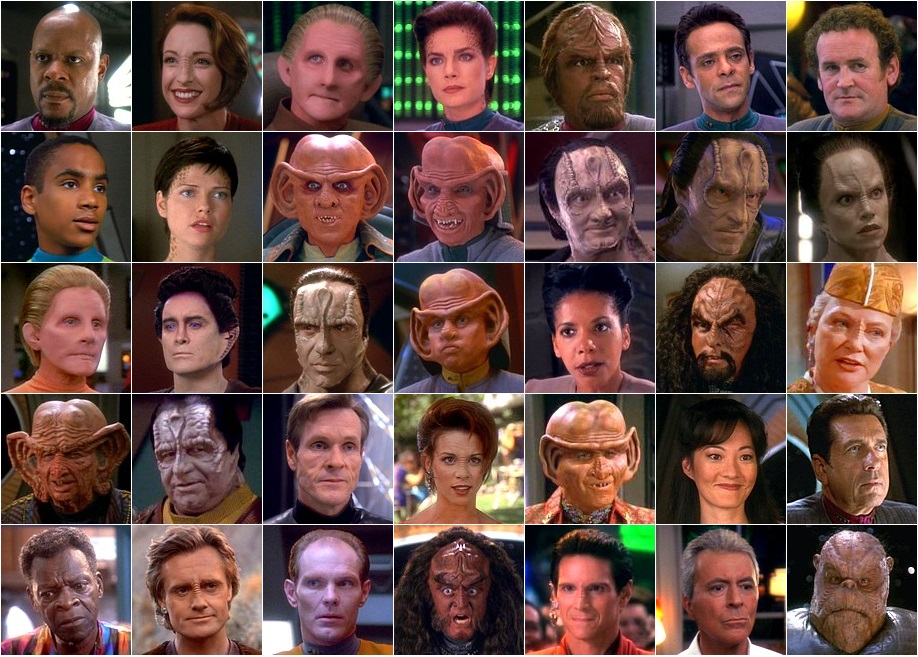

One of the greatest strengths of DS9 was not only a talented cast of core performers portraying memorable characters, but an equally talented cadre actors playing a rich and intriguing group of recurring characters. It soon became an ensemble show and we were thrilled as we learned more of these brilliantly written characters. It would be impossible to imagine the show without names like Garak, Dukat, Weyoun, Rom, Leeta, Nog, and Kai Winn. More than any other Trek series to date, no show had such a rich and diverse group of characters. They were not set in stone according to their motives as well. They would switch between hero and villain, crook and cadet, while adding to the interest of the story.


The stories, as well, became a calling card for the show. In the previous series, there were the occasional two-part episodes, but DS9 took that to a new level. Multi-episode story-arcs were tried and were largely successful. More than any other series in Star Trek (with, perhaps, the exception of Discovery) did the effects of one episode have such a lasting impact over the course of the show. Themes such as love, war, betrayal, and honor were woven into commentary of our world. Racism, genocide, terrorism, and socio-economic divisions were addressed in typical Star Trek fashion. They caused us to think about the world around us while we watched these characters explore the galaxy. New ground was broken and some classic episodes were made. From "Duet" to "the Visitor", from "Far Beyond the Stars" to "The Way of the Warrior" and "In the Pale Moonlight", storytelling was at an all time high.


Deep Space Nine kept true to the roots of established Trek while making some noticeable changes. The Trill may have looked different from when Beverly Crusher fell for Odan, but so many other cultures were further deepened. The Klingons were added into the mix heavily in Season 4, and the Ferengi were finally able to find a niche that they could comfortably fit into. The Bajorans and Cardassians that were created in TNG were given much context and depth. We even had a chance to
see some familiar faces from the past. There was a visit from Q, the Duras sisters, Vash, and Riker. We had Gowron do far more than he did in TNG, and a blast from the past with three original series Klingons reprised by the original actors with Kang, Kor, and Koloth. With all the nods and respect to the past, DS9 still went boldly forward with new races. Most notably were the many races related to the Dominion, which became one of the most intriguing and deadly enemies of the Federation.


It is sad that DS9 did not garner as much attention as TNG did. It would have been great to see at least one DS9 movie, but that does not diminish the greatness of this series. While it was not a perfect series, I must say that it is one of the most underrated television series that has aged very well. It's almost as applicable today as it was a quarter century ago. To celebrate this wonderful show, I will do as I did last year to celebrate the 30th anniversary of TNG by giving you ten episode reviews of some of DS9's best and brightest episodes. Hopefully they will include your favourites. So, grab some raktagino, fire up some Vic Fontaine music, and dust off the DS9 dvd set and relive some great television and science fiction.


To look at some previously reviewed episodes, click here.

For my favorite DS9 episodes, click here.

For my top 5 reasons why I love DS9, click here.