Showing posts with label Original Series. Show all posts

Saturday, September 15, 2018

Episode Review - Patterns of Force (Original Series, Season 2)


For those who are new to my episode reviews, you can find the post where I establish my point criteria here


Overview – The Enterprise travels to the planet Ekos to find John Gill, a Federation cultural observer who has gone missing. On Ekos, they discover the planet in conflict with its neighbor, Zeon, and Ekos has developed a regime almost identical to Nazi Germany. Kirk is shocked to learn that the Fuhrer of this regime is the missing Gill. While investigating on the planet, Kirk and Spock are captured by the SS. As they plot their escape, they must find a way to reach Gill and undo the cultural damage he has done.


Score: 8/10 – An interesting example as to why the Prime Directive must be adhered to, “Patterns of Force” gives us a chance to see how Kirk and crew would fare in Nazi Germany. I found this episode to be somewhat compelling and relevant to today’s climate. It is not unusual for science fiction to take lessons from Earth’s past and put a sci-fi twist on it to teach us something, and this episode is a prime example. We an ingenious jailbreak on the part of Spock, something we will see again. We are given excellent performances by all the actors involved, with special commendation given to Skip Homeier who plays a malicious Melakon. A solid episode that highlights the best that Trek can offer.


Relevance – 1 point. As I mentioned earlier, in this episode we get a glimpse into Spock’s ability to find ingenious ways to break out of jail cells. This is mentioned in “Star Trek V: The Final Frontier”.


Continuity – 2 points. Character continuity works. We see disappointment in Kirk as he learns what his former Academy instructor had done. We see resiliency in both Kirk and Spock as they are tortured by the Nazis. Universe continuity is also intact here. Of particular note, I appreciate how after Spock’s lashings he is shown to have green blood streaks across his chest. Story continuity bears a closer examination, however. We were told in “Bread and Circuses” about Hodgkin’s Law of Parallel Planetary Development, implying that it is possible for familiar historical events to develop independently between two worlds. In this episode, such a theory is either discarded or disregarded. That could be a bit confusing for the viewer that pays attention to such details, so we will have to deduct a point here.


Character Development – 3 points. Kirk and Spock are given the most character treatment, which is normal. Kirk has to deal with the mistakes made by an academy professor that he greatly respected and admired, a sort of “fallen hero” idea. It causes Kirk some concern. Spock shows off his intelligence and ingenuity by using the crystals in their transponders to make a laser that melts the lock of their cell door, establishing him as a master escape artist. Both of these developments and experiences do provide some significant development to these two characters, so full points are scored in this category.


Social Commentary – 3 points. The familiar “if you do not learn from history you are doomed to repeat it” warning and why the Prime Directive is the most important law in the Federation are fully on display here. Some people argue that because the Nazi regime was quite efficient (a point that has been disputed and to some discredited since) that it would be worthwhile to adopt some of its practices while hoping to avoid the more unsavory aspects of it. That is a slippery slope that is wisest to avoid rather than attempt to traverse. As with so many historical examples, this story shows that power corrupts the individual and the society. Nazism is not something to be admired, even and especially through the lens of history. Today we see examples of how people turn to extreme ideologies when pushed, either through fear or hardships. It is as important today as it was fifty years ago to be committed to resisting such rhetoric that not all equal.


Cool Stuff – 1 point. Spock’s use of the transponder crystals to make a laser is quite fun. Yes, some may describe it as a convenient plot device to help them escape, but it still made for a cool scene, so a point is scored.


Rank – Captain (18 points). A well-written episode that tells a compelling story and gives us a timeless message. It also cements the importance of the Prime Directive by showing us the worst-case scenario that results from its violation. This is one of the reasons why Star Trek was such a ground breaking series for its time in that it did not hesitate to tackle serious issues head on.


If you would like to read other reviews from the Original Series, click on the link here.

If you would like to read an episode review from any of the Trek series, click the following link to get to the series catalog. If the episode you want reviewed has not been done yet, then feel free to request it in the comments and I will see what I can do.


Thursday, July 26, 2018

Episode Review - Operation: Annihilate! (Original Series, Season 1)


For those who are new to my episode reviews, you can find the post where I establish my point criteria here


Overview – The Enterprise is heading towards the planet Deneva to try to establish contact with the colony stationed there. They are investigating a pattern of mass insanity that is moving on a straight line towards the colony. They pick up a ship on sensors that is headed towards the system’s sun. After a mysterious message from the pilot, the ship burns up. It is then revealed that Kirk has a brother on the planet. As they beam down to the planet they begin to investigate. They are attacked by group of men who are yelling at the away team to go away. After stunning the group. Kirk and his team find Kirk’s brother, George “Sam” Kirk, dead. His son is unconscious, and his wife is n hysterics. Beaming them back to the Enterprise, Kirk’s sister-in-law, Aurelan, tells Kirk of “things” that invaded their colony, and then she herself dies. They find some strange creatures, one of which attacks and infects Spock. Kirk is left with the difficult decision of destroying the colony to prevent the spread of the parasites, and he demands another alternative. A method is found, but it extracts a heavy cost on Spock.


Score: 8/10 – A good, solid episode to end the first season of Star Trek. There is mystery, humor, and risk all interwoven. James Kirk faces a great loss as his brother and most of his family die from the neural parasites. The parasites themselves are a cool alien prop and concept, and they add a great deal to the eerie feel of the episode. The method of killing the parasites has a few twists and turns and shows that our crew are not entirely infallible. When they use the bright light to kill the parasite that is living within Spock, it blinds our favorite Vulcan first officer. The revelation that it is UV light that kills the parasite makes Spock’s sacrifice seem in vain. Being the last episode in the season, it adds a certain amount of suspense, although in the 1960s it would have been uncommon to have such a major change to such a major character.


Relevance – 2 points. The inner eyelid of the Vulcans is mentioned in the Enterprise episode “The Forge”. While some might classify this anatomical feature as being akin to the deus ex machina solution, it does become an important feature of Vulcan physiology. I will also score a point for showing George Samuel Kirk’s family, which was mentioned in the episode “What Are Little Girls Made Of?”.


Continuity – 1 points. Character-wise we have one little issue. Kirk has some tough calls to make and is dealing with the very recent loss of his brother’s family, save Peter. Yes, as a Starfleet captain he must be tough against the trials that life in Starfleet brings. It is expected that Kirk show composure in light of this tragedy, but I did find it odd that there was very little shown about the captain’s handling of his loss. I get that Jim Kirk was closer to Spock and McCoy then his own brother, but I did expect some sort of extended emotional response to his loss. Universe continuity had to be deducted as well. While it was a cool feature of the neuroparasite, the biology teacher in me has to call out the idea that each floating fried egg was a single cell is not scientifically feasible. Cells are microscopic for a reason, and the scale of these organisms is just not going to cut it. So, while I like the organisms as a concept, and I get that not all scientific laws can be readily adhered to in science fiction, but I have to make a call, and the call is to deduct the point. Fortunately, the story continuity is fully intact, so the point is scored here.


Character Development – 2 points. Spock shows he is willing to give himself for the greater good by going to the planet alone, after being infected, to obtain one of the creatures. McCoy shows his deep respect for Spock when he refers to him as the best first officer in the fleet. Kirk has to make some tough choices after losing his brother. All of them see some growth in this episode, and yet it is all stuff that has been previously established. Still, it’s a good episode that highlights the three of them.


Social Commentary – 2 points. Here we see the needs of the many outweighing the needs of the few. Kirk having to make the difficult choice to destroy a million lives to prevent these parasites from expanding throughout the galaxy. Spock going to the planet to prevent the anyone else in the crew from being infected by the parasites. This is the usual “taking one for the team” attitude that we quite often find ourselves in. While we do not have to do this on the scale that Kirk and his crew do, it is still significant. It means we put off the things we would rather be doing to help those in need. It means we allow for the greater good to override a minority group. It may not always be the most ethical choice, and sometimes we go the route of the needs of the few outweighing the needs of the many.


Cool Stuff – 2 points. There is no way that I am not giving a point for the neural parasite. For a science fiction show in the 1960s, it was a cool creature that has a cool premise. Each one being like a cell of a larger entity is different. I also imagine being one of the set workers whose job was to move the parasite around the scene on a string, like some sort of weird puppetry act. If memory serves me correctly there is a blooper scene that is out there that shows the scene where Spock is infected by the parasite, except instead of being hit in the back, he is hit in the butt. I also want to score a point for having William Shatner play Sam Kirk, complete with distinguishing moustache. This, to my knowledge, marks the first time that a main actor plays a second character in the show. True, Sam is dead and has no dialogue because of it, but it is a cool feature.


Rank – Captain (17 points). This is a great episode that is a fan favourite. The effects of the creatures work well even today, and we get to see some great dialogue between the core three characters. Definitely a strong finish to a good first season.


If you would like to read other reviews from the Original Series, click on the link here.

If you would like to read an episode review from any of the Trek series, click the following link to get to the series catalog. If the episode you want reviewed has not been done yet, then feel free to request it in the comments and I will see what I can do.


Friday, February 2, 2018

Episode Review - Let That Be Your Last Battlefield (Original Series, Season 3)

For those who are new to my episode reviews, you can find the post where I establish my point criteria here.


Overview – The Enterprise is on an urgent mission when it detects a shuttlecraft stolen from Starbase 4 weeks earlier. Seeing that the shuttle is damaged and that the life support systems are failing, Kirk orders a tractor beam to bring the craft aboard. The pilot, an unusual looking alien who is white on the right side of his face, is taken into custody. He identifies himself as Lokai, from the planet Cheron. As they continue to their original heading, they encounter another strange vessel, this time transporting a member of the same planet, only he is white on the left side. His name is Bele, and he has been hunting Lokai for 50 000 years. He demands custody of Lokai, who claims political asylum. Between the two arguing with each other, Kirk and his crew soon learn that the people of Cheron live in a society where the ones who are black-right have a great deal of power over those who are white-right. They both display unique powers which leaves Kirk in a precarious position as he tries to find a solution to their millennia-arching hatred while protecting the Enterprise and her mission.


Score: 8/10 – Star Trek became well renowned for its ability to comment on social issues of the day in a way that was unique due to the science fiction nature of the show. Indeed, “Let That Be Your Last Battlefield” is often a cited as a prime example of this. Here, the writers tackle the issues of racism in America by creating a world where everyone is both black on one side and white on the other. The difference is in which side is which color. We are then taken into a conflict that has spanned tens of thousands of years, if not more. In the end, we see that the hatred each side had for the other doomed the civilization to annihilation. We get great performances from the two guest stars, Frank Gorshin and Lou Antonio. They play their parts well, mixing anger and hatred with a sense of justice (for Bele) and sympathy (for Lokai) effectively. While the social message of this story is about as subtle as an explosion, it is still a very powerful message. There are a few parts of the story that I wish had been more fully explored, such as if Lokai had similar abilities as Bele with regard to taking over the ship. I also found the end scene of the two aliens chasing each other through the corridors of the ship to be a bit drawn out, although it was partly made up for with the stock footage of burning buildings to show how each of them envisioned the destruction of their homeworld. For its time it was an effective use of imagery. When the crew is left on the bridge contemplating and discussing the futility of the hatred that Bele and Lokai had for each other, we the audience are also left questioning the futility of hatred in our own world. That is what good television, and good Star Trek, is all about.


Relevance – 1 point. This is a tough one, and it hurts the overall scoring of this very worthy episode, but try as I might there is only one part of this episode that has any bearing on anything else in the franchise. When Kirk is forced to use the self-destruct sequence to prevent Bele from preventing the Enterprise in reaching her mission, they format of the code is the same as will be used to destroy the Enterprise in Star Trek III. Even though this episode can stand on its own, and if you miss it you will not be losing any understanding or connections to anything else in the franchise, this is still very much an episode to watch


Continuity – 2 points. Giving a point for both universe and character continuity here. For the universe, I almost took a point off for having a planet full of such powerful and long-lived beings that it was amazing to me that nobody in the Federation seemed to have heard of it before. But, space is big, so I can let that slide. Character continuity is also intact here. I especially appreciated how the scene where Lokai is trying to recruit sympathy for his people among the crew, he is discussing it with Sulu and Chekov, among others. While it was interesting that Chekov, a Russian, and Sulu, a Japanese, were acknowledging that persecution existed on Earth at that time, they had shown that Earth had largely moved on from it. Where I have to take a point away is in story continuity, and it is for two instances. First, in the just mentioned Lokai recruitment scene, he is seen speaking to four members of the crew, one of whom is Sulu. The point of view focuses on Spock listening in the hallway. We then hear Chekov’s voice in the conversation. As the camera focuses back into the room, there is no Chekov visible. Also, in the end when Spock is monitoring the movements of Bele and Lokai throughout the ship, he is able to give Kirk and the bridge crew a play-by-play description of the chase. He is able to indicate who is where in the ship and where they are headed. Then, as Lokai enters into transporter room, and everybody cannot explain why the transporters are being activated. With Spock being able to report where each of the two are, it is odd that they would not be able to make a simple deduction as to who was transporting to the planet.


Character Development – 1 point. Again, it pains me to rank this as this is an excellent episode, but this story is largely an analysis of two guest characters, neither of whom add anything to the development of any of the main characters. Everyone is very sympathetic to the situation, at least. There is one major revelation about Kirk here, and that is found in the scene where he sets the auto destruct of the ship to prevent Bele from commandeering the ship. It shows his resolve (and, possibly, his bluffing abilities). It highlights that Kirk means business here, and if it means he destroys his vessel and crew, so be it.


Social Commentary – 3 points. OK, here is where there is no doubt as to giving it full points. Racism was definitely the focus of this episode. In a time when racial tensions in the US were particularly high, Star Trek was able to address it in a way that gave everyone watching it a chance to sit back and think. A simple yet brilliant move in making both central guest characters black and white, just on different sides, was very effective at pointing out the sometimes silly nature of racism. It does not matter what the skin coloring is, there is nothing that truly separates them other than their own prejudices. Add to that is the distrust each has for the mono-colored skin colored captain and his crew who cannot possibly understand how they feel. In the end, we see what this sort of hatred and pettiness can lead to, and that is the complete destruction of their civilization. Of particular note, however, is that this message is still needed today. Perhaps it is even more relevant today, and I am not just talking about racism here. Our Western society has been embroiled in polarizing divisions for some time now. Racism is only one facet of this stone. There are so many ways that this type of mistrust and hatred can be seen, from religion to politics, from socio-economic status to philosophy. What really makes this episode powerful is that while we may have sympathy for Lokai, being the member of the oppressed group, he is not innocent here. As we see in the aftermath of the battle on the planet, both sides were guilty of fueling their hatred towards each other. Lokai had given into hatred as much as Bele did. Too often in these disputes both sides will claim to have the moral high ground, and in the end we see that neither does. No matter how justified, hatred really accomplishes little that is good.


Cool Stuff – 2 points. I am scoring a point for the memorable visual of Lokai and Bele. A quick and simple way to divide the two men from the same planet that really establishes how silly their fight is. One feels superior to the other because their colors are reversed. Both characters kept their gloves on during the episode to prevent the make-up people from having to add make-up to their hands, which is an acceptable way of maintaining costs on the show. I also want to score a point for Frank Gorshin as Bele. Gorshin was probably best known as the Riddler in the Batman series starring Adam West. It was interesting seeing him play such a different character here.


Rank – Captain (17 points). Such a strong episode that gives us a great message in a powerful way. Yes, the approach is blunt and obvious, but the execution is nearly perfect. Definitely one to watch.


If you would like to read other reviews from the Original Series, click on the link here.

If you would like to read an episode review from any of the Trek series, click the following link to get to the series catalog. If the episode you want reviewed has not been done yet, then feel free to request it in the comments and I will see what I can do.


Tuesday, November 21, 2017

Episode Review - I, Mudd (Original Series, Season 2)

For those who are new to my episode reviews, you can find the post where I establish my point criteria here.


Overview – The Enterprise is commandeered by Crewman Norman, who is revealed to be an android. The crew find themselves orbiting an unknown planet. When Norman forces Kirk, Spock, McCoy, Uhura, and Chekov to beam down to the planet, they discover that the planet is populated by androids, with the rascal Harry Mudd as their leader. Mudd informs the captain that after escaping prison, he found himself on this planet where he took the position of being leader of the androids. Unfortunately for him, the androids would not let him leave, so he sent out Norman to acquire a starship. By bringing the Enterprise to the planet, Mudd intends to leave Kirk’s crew behind as he leaves with the ship controlled by androids. Unfortunately, the androids have a different idea and soon Kirk, his crew, and Mudd must work together to stop hundreds of thousands of androids from establishing their order throughout the galaxy.


Score: 8/10 – “I, Mudd” is a delightfully light-hearted tale that brings back fan-favourite Harcourt Fenton Mudd. I actually enjoyed this episode better than “Mudd’s Women” due to the humor and levity. While the story is not terribly complex, it is enjoyable and gives some great comedic moments for many of the crew. The banter between Kirk and Mudd is very entertaining, and the methods that the crew utilizes to deactivate the androids is fun, albeit silly. I particularly enjoyed the Stella android that Harry made, allowing him to get his last word in with his estranged “wife”. The sense of danger is never really present, although it is teased just a bit when it appears that Uhura is wanting the android body promised her to the point where she “betrays” the plan of the crew. It was, in fact, a ruse within a ruse. So while nothing very serious occurs, it is an entertaining adventure for our beloved crew. Oh, and the end fate for Mudd is likely one of the most fitting outcomes for any rascal that has ever tormented the crew of the USS Enterprise.


Relevance - 2 points. One point scored for picking up from where “Mudd’s Women” left Harcourt Fenton Mudd. Another point for the depiction of his estranged wife Stella, although in android form. Looking at the episode from Discovery that had her appear in it, I think they cast the younger version


Continuity – 3 points. Story line works out well. Using illogic to mess with the androids was quite clever and well done. Universe works well. The limits of androids shows how they do not seem to be used a whole lot in the 23rd century. Character continuity is also intact. In particular, I think Mudd was able to tempt the crew members in the appropriate ways (McCoy with the science lab, Uhura with eternal beauty, and Chekhov with women), but as to be expected each of them was more than able to handle and overcome the enticements Mudd offered. Kirk’s banter with Mudd reminds me a lot of his witty sarcasm he uses in “The Trouble with Tribbles”. Full points across the board here.


Character Development – 1 point. Because this episode is very silly by nature, we really do not get a lot of insight into the characters. We see some of their weaknesses with the different temptations they are given, but nothing out of the ordinary or of a revelatory nature. If anything, we showcase Kirk’s wit and Spock’s logic, but beyond that there is little that really moves any character forward.


Social Commentary – 2 points. The life of ease that Mudd relished is often less appealing in the long run. We often would jump at the chance to have our every desires granted to us, and yet Mudd’s experience shows us that we would end up enslaved by the experience. Harry Mudd had it all, and yet when he wanted to leave he learned that he was indeed a prisoner of his slothfulness. In our own world, we need to remember that there is great freedom and liberation in hard work and effort.


Cool Stuff – 2 points. I love the ending, when Harry Mudd is left with up to 500 copies of his nagging wife-droid, only unlike the original they are unable to be shut down by “Shut up, Stella!”. I also liked how they were able to cast sets of twins for several of the androids, allowing them to have the effect of multiple versions of the android without resorting to the special effects. It was a clever and practical solution, so I score a point there as well.


Rank – Captain (18 points). A much better Mudd episode, “I, Mudd” gives us some great comedy. It is fun watching the crew act in a way that is so illogical, resorting to using their cunning to escape the predicament instead of brawn. Fans of Harry Mudd should welcome this episode.


If you would like to read other reviews from the Original Series, click on the link here.

If you would like to read an episode review from any of the Trek series, click the following link to get to the series catalog. If the episode you want reviewed has not been done yet, then feel free to request it in the comments and I will see what I can do.


Tuesday, October 24, 2017

Episode Review - The Squire of Gothos (Original Series, Season 1)

For those who are new to my episode reviews, you can find the post where I establish my point criteria here.


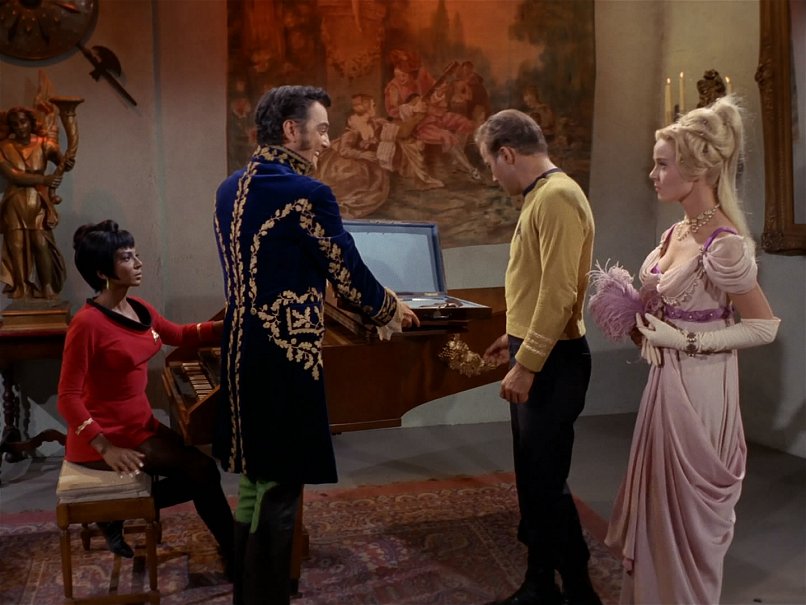
Overview – The Enterprise is passing through a void in space with very few solar systems en route to the Beta VI colony. When the ship encounters a rogue planet, Sulu and Kirk disappear from the bridge. As Spock and the rest of the crew search for their missing shipmates, they discover them on the planet in the custody of General Trelane, the self-proclaimed Squire of Gothos. The crew then find themselves at the mercy of this powerful being who has a great understanding and fascination with ancient Earth culture.


Score: 7/10 – The Squire of Gothos is a fun romp that again pits the crew against a being of immense power. Some have since theorized that Trelane is a juvenile member of the Q-continuum, but this theory has never been officially substantiated (the novels don’t count). What we do know is that William Campbell, who will go on to play the Klingon Koloth in the classic tribbles episode, takes on the role of the Squire with a relish and infectious energy that makes him an endearing adversary. It is nice to see the crew in the beginning of the episode work without the captain, giving Spock command of the ship and he handles it well. The banter between Kirk and Trelane is lively and clever. The different failings in Trelane’s recreations are logical for the character. The story meanders a bit as Kirk and crew face and overcome one Trelane-induced obstacle after another. At one point I felt that Trelane was acting like an over-indulged spoiled child, and then the reveal at the end of the episode confirms my sentiments. So while the episode has some weaknesses, Campbell’s energetic performance makes it an enjoyable one, at least.


Relevance – 2 points. A point is scored for the salt-monster from “The Man Trap” appearing as one of Trelane’s statue decorations. McCoy does a great shocked look when he sees the creature again, establishing that he remembers the near death experience. A second point for the first appearance of Lt. DeSalle, who will return in “Catspaw” and “This Side of Paradise”.


Continuity – 2 points. Character continuity works. Of particular note, I liked how when the banquet was offered to the away team, McCoy just picked up a plate and started digging in. He is, if nothing else, a very practical doctor. Kirk also acts the way that we are accustomed to, especially when he goads Trelane. Story continuity also works out here. Where I will deduct a point is in the Universe continuity. It is stated that Trelane is seeing 900 years into Earth’s past, and yet if this is true, then based on the time era that Trelane is obsessed with, this should be taking place in the 27th Century, not the 23rd.


Character Development – 1 point. Spock is put in command of the ship as soon as Kirk is abducted. We see him come up with some ingenious strategies in getting the away team back. Both he and Kirk match up against Trelane, with Kirk usually taking the lead. There is not much significant for either of these two, however, and I wouldn’t say that the episode really advances anyone’s character much, so this is minor development at best.


Social Commentary – 1 point. As fun as Trelane is, what does the Squire of Gothos really teach us? How to deal with a spoiled brat of a kid with god-like powers? With that, I think Spock gives us something to consider when he announces to Trelane that he “objects to intellect without discipline” …” to power without constructive purpose”. Beyond that statement, it is hard to see how the story gives us anymore insight into that theme. It is simply Kirk and company trying to outwit the trickster. So apart from a few statements, there is really nothing that drives the point home. Still, it is a lot of fun to watch, even if it doesn’t give us much to think about after.


Cool Stuff – 2 points. I have to score a point for Trelane. He is such an over-the-top character and Campbell plays him with such zest and energy that it is hard not to like him. I also scored it a point for the salt-sucking monster from “The Man Trap” making a cameo and scaring the doodles out of McCoy.


Rank – Lieutenant (15 points). A very popular episode with a talented guest star in an entertaining role. While the story has some issues with keeping the pace focused, it is entertaining. While I suspect that some may want to skip past this episode, I would offer that while we may not gain some greater insight into the human condition, it is a good episode in that the story is entertaining. If you want to challenge me to a duel over it, I await your glove-slap.


If you would like to read other reviews from the Original Series, click on the link here.

If you would like to read an episode review from any of the Trek series, click the following link to get to the series catalog. If the episode you want reviewed has not been done yet, then feel free to request it in the comments and I will see what I can do.