Showing posts with label movies. Show all posts

Friday, January 20, 2017

Top 10 Star Trek Movie Villains - Part 2


In my last post I talked about numbers 10-6 of the top Star Trek movie villains. If you want to check it out, just read Part 1. If you want a quick recap, they were:

10. Sybok
9. Khan (Into Darkness)
8. Shinzon
7. Nero
6. Soran

Now, let's take a look at the Top 5, starting with...

5. Krall (Star Trek: Beyond) – Ah, now we are striking some gold! In Star Trek: Beyond we are introduced to the demonic looking Krall, played with ferocious intensity by Idris Elba. Formerly the Starfleet Captain Balthazar Edison, Krall uses alien technology he discovered on the planet Altamid to prolong his life and to formulate a plan to destroy the Federation. It does not take long for Krall to destroy the Enterprise and imprison much of her crew while he strikes out at starbase Yorktown. Krall demonstrates a villain with a cause and a blood-thirsty attitude that has been lacking in many of Trek’s villains that appear lower on this list. He has a plan, and it is huge. Some have said he could be Trek’s poster child for PTSD that afflicts too many of our veterans. His actions are brutal and terrifying, and he has the face to match. His use of the alien technology mutates him into a demonic looking warlord, giving us a nice little surprise when we learn his origins. More than Nero, more than Kelvin-Khan, Krall gives Kirk and company a genuine fight. If it hadn’t been for that blasted Beastie Boys song, he might have destroyed the starbase and everyone on it. My only complaint with him is that he spent much of the movie arguing that the diversity in the Federation was its greatest weakness, and yet when Kirk finally defeated him, there was nothing in his downfall that proved his theory wrong. He was bested by a better warrior and tactician, but there was no indication that the diversity he so despised was not the weakness he claimed it to be. Still, as far as villains that have actually destroyed the Enterprise, he was the most fearsome and effective in all the Kelvin Timeline films.


4. Chang (Star Trek VI: The Undiscovered Country) – How can you tell that your Klingon opponent is tougher than most? When he has his eye patch bolted to his skull. The talented Christopher Plummer gave us one of the most unique looking Klingons to serve as main adversary in the final voyage of the original crew. On the eve of peace between the Klingon Empire and the Federation, there were those who wanted to tear those plans asunder. The tension between these two super powers was easily compared to the Cold War between the USA and the USSR at the time, and as in the real world there were the old dogs on both sides who had difficulty letting go of past mistrusts, so too in Star Trek. Chang was the epitome of this. He orchestrated the assassination of his own Chancellor, collaborated with the enemy to sabotage the peace talks, and with his state-of-the-art bird of prey (that just so happened to have the ability to fire when cloaked) almost destroyed the Enterprise and her crew. His love for Shakespeare (in the original Klingon, of course) added a witty dimension to his character, and he delivered his lines with delectable emotion. We suspected from the trailers that he was up to no good, but we didn’t need to be surprised in the reveal of his part to enjoy the destruction he brought to the story. He was the ideal foil to Kirk, and his defeat at the end was satisfying.


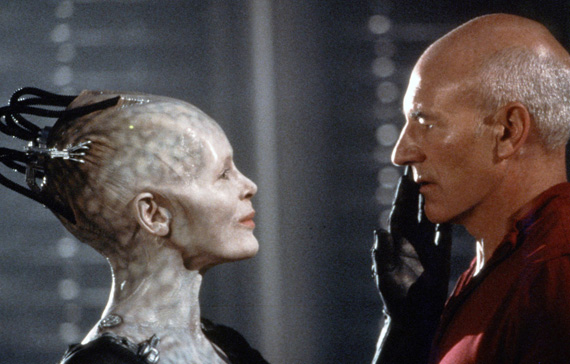
3. The Borg (Star Trek: First Contact) – if ever there was an enemy from one of the TV series that was made for the movies, it would be the Borg. In First Contact, they are back with a vengeance. A single cube decimates another Federation armada, but is soon stopped by Picard and his crew of the new Enterprise E. That it is far from the end, however. Unlike before, the Borg had an extra trick up their collective cybernetic sleeves. A smaller sphere vessel escapes the cube’s destruction and goes back in time, assimilating Earth of the past. Picard follows and destroys the sphere, but not before the Borg beam aboard the Enterprise and starts to assimilate the ship. During this, we are introduced to the Borg Queen, played with delicious mastery by Alice Krige. She is the collective. Upon capturing Data begins to seduce him to her side, promising him the gift of merging his synthetic with the humanity he has always desired. The Borg, as shown many times in the Next Generation, always seemed to be so very close to beating the Federation. In arguably the strongest of the TNG films, the Borg are just as relentless as we had come to expect, but the addition of the Queen added to the stakes like never before. Her introduction was one of the best effects in the franchise, and her individuality added a great layer of complexity to the most feared enemy. Their goal was simple: assimilate humanity. They again came so close to succeeding. If only she hadn’t underestimated the will and loyalty of Data, she just might have done it.


2. Kruge (Star Trek III: The Search for Spock) – OK, for the #5 entry I claimed Krall was the best villain to have destroyed the Enterprise, but what about Kruge? Simple, Kirk destroyed the ship, not Kruge, but it was the only way Kirk could win. That is what made this Klingon such a threat. Kruge was masterfully portrayed by Christopher Lloyd with relish and calmness. He was an intriguing foe for Kirk. First, he felt completely justified in his actions. He saw Kirk and the Genesis device as a legitimate threat to the Klingon Empire. So he went about to acquire all information he could. He was able to tie up loose ends, even if it meant personal sacrifice (RIP Valkris). He would quickly and severely deal with incompetence on his ship. Remember the poor gunner who was vaporized after his “lucky shot” destroyed the USS Grissom? In later generations, we learned that such is often the way on Klingon warships, but Kruge did it first. He also cared. He cared about his dog…lizard…uh, whatever that was. He cared about his crew, as he demonstrated when Kirk tricked most of them onto the Enterprise just as is it was about to self-destruct. He cared about the glory of the Empire. I suspect that is he had somehow survived and lived long enough to see peace made between the Klingons and the Federation, he would not have changed much and likely would have fit in well with the likes of Gowron and Martok. He caused the death of Kirk’s son, showing strength in his resolve. Up until the end, Kruge fought for the Empire. While his actions were brutal and calculated, his motives were understandable. He was much more complex than many gave him credit for.


1. Khan Singh (Star Trek II: The Wrath of Khan) – Ah, Khan. With all due respect to the supremely talented Benedict Cumberbatch, nobody does the genetically enhanced superman like the delightful Ricardo Montalban. It is true that Khan had the benefit of already having a back story to establish his wickedness (see the first season episode Space Seed), but it took nothing away from how wonderful an adversary he was. He committed horrible crimes of murder and mayhem, torture and treason, all in the name of vengeance. Long before Picard was compared to a certain peg-legged whale hunter, Khan personified the trait of revenge. He was clever, devious, charismatic, and ruthless. Where Kruge and Chang did what they did out of loyalty towards their empire, and the Borg out of a goal to achieve ultimate perfection, Khan did what he did out of a personal thirst for revenge. Where Nero, Shinzon, and Krall had similar motives, it was Khan that took it to the personal level. The others had an out-of-control rage that boiled over on numerous occasions, Khan was mostly in full control of the situation. His intelligence and self-discipline allowed him to bring Kirk to the brink of defeat. Even as he breathed his last, he felt that he had, at the very least, taken his hated foe with him. Had it not been for Spock’s ultimate sacrifice, Khan would have succeeded. He was a villain with nothing to live for but revenge, and he almost had it. And not once did he ever face Kirk in the same room. His mere presence on the view screen was enough to elicit fear in those who had faced him before. There are many reasons why Wrath of Khan is considered to be the best Trek film of all time, and Khan would definitely be a huge factor in making that case.


So, there they are. How did your favorite movie bad guy fare? Any surprises? Leave a comment.


Tuesday, January 17, 2017

Top 10 Star Trek Movie Villains - Part 1


In all forms of art and literature, a great villain can make or break the story. The proper antagonists allows the heroes to triumph by providing them the proper adversity to overcome. In fact, some would argue that the villain creates the hero. There would be no Indiana Jones without the Nazis, no Batman without the Joker, and no Luke Skywalker without Darth Vader (which, technically, is literally true as he is Luke’s father). Some villains are simple, yet effective. Others are more complex and intricate. Some villains earn our sympathy, while some are just pure evil. Regardless of their character, they can often make the story so much more entertaining. 

Star Trek is no different. In the 13 movies that have featured the crew of the Enterprise, there has always been a villain that brings us the conflict. Ranging from cybernetic collectives to mad scientists, devious clones to vengeful past foes, cunning generals to even a probe looking for its whales, a formidable adversary can always be counted on to bring out the best in our beloved characters. In this two-part Top Ten list, I will explore who I think are the ten best villains from the Star Trek movies. I considered the main antagonist in each film, ranging from the Motion Picture to Beyond. I will look at what dastardly deeds were committed, their impact on the main characters, how well their own character was developed, and the simple fact as to how cool they really were. While the villain can make all the difference in the movie, sometimes a bad movie hurts what on paper would be a pretty great villain, and that will also be a factor in this list. How does your favourite movie baddie match up against this list? Oh, and just in case you have not seen all of the movies, some SPOILERS ALERT is in order.

10. Sybok (Star Trek V: The Final Frontier) – At the bottom of this list is Spock’s half-brother. The son of Sarek and a Vulcan Priestess, Sybok abandoned the emotional suppression of his Vulcan heritage and began a quest to discover God. Literally. He went looking for the Almighty himself. He started on a dingy, dusty planet that the Klingon, Romulan, and Federation governments would send their least desirable diplomats to as a token symbol of peace. Not a difficult place to conquer. What was strange about Sybok is that he had some sort of hypnotic power that could earn the trust of those around him that only a stereotypical religious cult leader could muster. The trouble with his role as a villain is that he isn’t really bad. Sure, he takes over the Enterprise (which is why he ranks on this list, unlike three bad guys who don’t), but he does so to find God. Not destroy the universe, or conquer it, but to enlighten it. He brainwashes people by showing them their pain and then having them give to him their pain, but all he does is make them devoted to him in a weird, cult-like sort of way. One of the many reasons that Star Trek V was almost universally panned by fans has to do with such a weak villain. I think that the actor, Laurence Luckenbill, did the best he could with the material given, but the character was a flop, and landed him at the bottom of the list.


9. Khan (Star Trek: Into Darkness) – Benedict Cumberbatch is a talented and gifted actor. His inclusion as the villain in Into Darkness was heralded as a major coup. For months rumors circulated that he would take on the iconic role of Kahn Singh, Eugenics War tyrant that brought such a heavy toll to Kirk and crew in both the TV series and the movies. He was introduced to us as John Harrison in an attempt to make his true identity a surprise. In many ways, he was everything that the Ricardo Montalban version was not. He decimates a Klingon strike force single-handedly with deadly ease. He kicks butt and takes names. While it was impressive, I must admit that this is part of the reason he shows up so low on this list. It was almost "over the top, action star quality", whereas the Prime universe version, while being violent and deadly, was more subtle, and thereby more dangerous. Also, since Into Darkness was in some ways a retelling of Wrath of Khan, the parts that seemingly played homage to such a masterpiece of cinema fell a bit flat. For fans of the original series, the comparison to the original Khan was mostly a pale one that relied too much on previously established material on the character. For fans unfamiliar with that movie, the significance was lost on them. Hats off to Cumberbatch for a strong performance, but the Kelvin Khan just doesn’t measure up to the original.


8. Shinzon (Star Trek: Nemesis) – Another excellent actor playing a villain that did not quite live up to the hype. Tom Hardy takes the role of the discarded clone of Jean-Luc Picard that has killed his way to the top of the Romulan Empire and has now set his sights on destroying the Federation. He is brutal in his methods, wiping out the entire Romulan senate in grisly fashion. His henchmen, the impressive looking Remans, add an almost vampire-like eeriness to things. His ship, the Scimitar, is menacing. His obsession with his Federation counterpart and DNA donor is more curious than troublesome, and this is where he starts to lose footing on this list. While he is tough, complicated, and dangerous, for a significant part of the movie we wonder what he is all about. And not in a “good, mysterious” way, but more like a “why on Earth is he so hung up on Troi” way. Still, he is responsible for the demise of Data, and that counts for something. He almost destroys the Enterprise E, and that is also noteworthy. He just does not come across as complex as some hoped and thought he would.


7. Nero (Star Trek, 2009) – As we go farther up this list, we start looking at what really makes a good adversary. In the first of the Kelvin timeline films, we are introduced to Nero, a troubled Romulan who intends to seek revenge for the destruction of his planet by striking at his enemies in the past. His ship is huge and deadly, but almost too complicated. His motives for what he is doing are intriguing, but here is where I think that, unlike Kelvin-Khan, he was too underplayed. Nero is devious, a killer, and commits some of the most heinous actions in any Trek film by destroying the entire planet of Vulcan. He has a well thought out reason for doing this, but it is hardly touched on. When you watch the deleted scenes from the DVD, we learn much more about the character that makes him a much more effective villain, but since it was all cut from the theatrical release, he becomes a two-dimensional character. All he wants to do is destroy because he is mad. Definitely a more effective villain than the ones previously mentioned, but he could have been so much more. The destruction of Romulus was mentioned almost in passing, and his back story could have done so much more for the character. Sadly, the producers missed the boat with Nero, and he only lands in the seventh position.


6. Soran (Star Trek: Generations) – Veteran actor Malcom McDowell let the cat out of the bag early by revealing that his character, the El Aurian scientist Soran, kills the legendary James T. Kirk in the movie that passes the torch from the original crew to the next generation. In the original version, Soran shoots Kirk in the back. Once fans started to complain about the reveal, reshoots were made that went from having Kirk not die to ultimately dying from a long fall. Again, this is an instance where more back story to Soran’s character might make him a more compelling villain. His motives are more self-centered on regaining something precious that he lost, not caring as to how he regains it. To have improved on his character, it would have been interesting to see the parallel between him and Guinan more fully fleshed out. So why so high on the list? While the Duras sisters destroyed the Enterprise D, it was because they had Soran’s help. He did kill James T. Kirk, which is no small feat, and therefor he ranks a bit higher than the likes of Nero, Shinzon, and Kelvin-Khan on this list.


Haven't seen your favorite yet? Well, stay tuned. My next post will be Part 2!

Thursday, December 8, 2016

Celebrating Star Trek VI: The Undiscovered Country


25 years ago Trekkies were celebrating the 25th anniversary of their beloved franchise. The Next Generation was riding high in ratings and reviews. A new series, Deep Space Nine, was just beginning to form in creative minds. Fans were most excited about the newest movie that was to be released on December 6, 1991. It was given the title “The Undiscovered Country” and it was being billed as the final voyage of the original crew. Leonard Nimoy, most famous for his role as everyone’s beloved Vulcan, Spock, was one of the major creative forces behind this film. Not only was he taking on his regular acting role, but he served as one of the story writers. Directing this movie was the talented and beloved Nicholas Meyer, who was widely revered for directing “The Wrath of Khan” and credited with setting the bar for all Trek films. The celebration was a bit subdued, as a few weeks before its release, Star Trek creator Gene Roddenberry had passed away. The movie was dedicated to Gene, who was able to watch it two days before he passed.


Star Trek VI was the only Trek film (to date) that I had the privilege to see in a special advance premier screening. I was a high school student living just outside of a small rural Alberta town, and the movie was being shown in Edmonton, one hour drive away. As both of my parents were unable to go, we called upon a family friend to take me. There was a bitter blizzard that evening, and after a few vehicular mishaps, the two of us finally managed to get ourselves seated in the theater just as the trailers ended. There is nothing like watching a Trek film with the room packed full of Trekkies. When the opening image appeared, Gene’s dedication, we all cheered. Then the music started, and we prepared ourselves for an amazing ride of thrills and nostalgia. The opening credits elicited many more cheers as the names of William Shatner, Leonard Nimoy, Nicholas Meyer, and others appeared. Then, as the introductory music faded, Praxis exploded, and we were off.


The Undiscovered Country may not be my favorite Trek movie (Wrath of Khan forever!), but it in no way disappointed us. After the poorly received fifth movie, many wondered if that was it for the franchise in film. Thankfully, the powers at Paramount Pictures wanted something special for the 25th anniversary and a more fitting send off than Star Trek V, and #6 delivered. Big time. It has everything that is needed to be a great Trek film. A compelling story that spoke directly to current events of our time (in the story, while the Federation and Klingon empire were seeking peace, America and its allies were coming closer to ending the cold war against the USSR). There was action and humor, suspense and fondness. The pacing of the plot was near perfect, and when the end approached, we had arguably the best moment of closure with the signatures of the actors we had loved for so long appear on the screen as a thank you to us fans. We left the theatre knowing that we had just completed a fitting sendoff to our dear crew of the USS Enterprise.


There are many aspects of this movie that I love. Indulge me in mentioning a few. First, there were some great guest characters. We saw a few old favourites. Admiral Cartwright was back, played once again by the impressive Brock Peters (we had last seen him in Star Trek IV: The Voyage Home). John Schuck also reprised his Voyage Home character as the Klingon ambassador to the Federation. Of course, we had Mark Leonard reprise Sarek for the final time (he had just appeared on TNG in Part One of Unification). Some new characters played by seasoned actors were introduced. Kim Cattrall, soon to be of Sex and the City fame, pulled off a fairly good Vulcan in Valeris. David Warner gave depth to the Klingon Chancellor, Gorkon. Kurtwood Smith played the Federation President, his first of three Trek roles. Super model Iman played the shape-shifting Matria. Rene Auberjonois, who we would grow to love as Constable Odo on DS9, was the treacherous Colonel West. We even had Michael Dorn play the grandfather of his TNG character, also named Worf. That’s a lot of star power.


Best of all, however, was General Chang, deliciously played by Christopher Plummer. I would likely rank Chang easily in my Top 3 Trek movie villains. He was cunning, intelligent, witty, and could quote Shakespeare in both English and its original Klingon. Plummer stole virtually every scene that he was in, and Chang sparred with Kirk like few could. I loved watching the final battle scene for nothing more than the gusto that Plummer brought to it. I have never been able to hear the line “Cry havoc! And let slip the dogs of war!” since without hearing Chang’s delightful voice. If nothing else, you have to admit that only a Klingon warrior would bolt an eye patch to his head. Sorry Martok, but Chang proved he was far tougher.


The story was so poignant and relevant to the world that was in 1991, and in many cases is even more so now. For the first time, our cherished heroes had to confront their prejudices. Klingons had been the enemy for so long it was easy to hate them. As much as Gene wanted the future to be all rainbows and utopia, even the most morally aligned characters have their flaws. The verbal debate between Spock and Kirk at the beginning of the mission highlights this. When Spock tells Kirk that the Klingons are dying, Kirk emphatically responds “Let them die.” In the movies, Kirk developed every reason to hate the Klingons, and he held onto that hate for many years. Likewise, Spock also had his prejudices towards the superiority of Vulcan morals. He had difficulties believing that his own protégé was a traitor due to her heritage. It took both of these iconic characters a great deal of courage and inner strength to admit and overcome this. Twenty-five years ago, as I mentioned, both sides of the Cold War were learning to overcome decades of distrust against each other. Today, we see the divisions more clearly and deeply as our world is divided on everything from religion to politics to race and to ideologies. Each of us needs to make a careful examination of our own prejudices and see what we need to do to keep them in check.


Most of all, the greatest strength of the film was the core group of characters that we had faithfully watched and re-watched for a quarter of a century. Everyone had some great moments. Kirk, Spock, and McCoy all had a great deal of limelight, but we saw great contributions from all the others. Scotty made some key discoveries in the investigation of the conspiracy, Uhura puts her linguistic skills to good use in crossing the Klingon border, and Chekov gets some of the greatest one-liners in the franchise’s history (“Guess who’s coming to dinner”). Most notably was Sulu, now Captain Hikaru Sulu of the USS Excelsior (a Search for Spock throwback). This was the decision that, for me, signaled that this was indeed the end for the original crew. They were finally starting to go their separate ways. This was, indeed, good bye.


Finally, I think that Undiscovered Country was a great movie for bringing closure to this wonderful televisions series that stretched into the feature films. Because it was cancelled after the third season, there wasn’t a final hurrah for the Enterprise and her crew. All of the other television series had it, but not the original. Since this was indeed the final voyage, we fans were able to send off Kirk, Spock, McCoy, Scotty, Chekov, Uhura, and Sulu in grand fashion. I felt that this was by far a better send off than Picard and company received in Nemesis as it left us with a satisfying sense of completion, which is something that every good franchise will eventually need. While the franchise would continue in some shape or form for another twenty-five years (and counting), this was a necessary final chapter for a cast of characters that are permanently etched into the annals of science fiction and pop culture. The Undiscovered Country proved to be more than worthy of a final ride into the sunset, and it ended with the most fitting of final lines, which also seems to set the tone for ending this celebration.

Second star to the right. And straight on ‘til morning.


Sunday, March 6, 2016

Top 10 List - Pre-Reboot Movies Part 2


Last post (not counting the news update), I ranked the bottom 5 of the ten pre-reboot Trek films. Today, we look at the top 5. I expect this list to be a tougher one to figure out, and I suspect that there will be a bit more disagreement, but that is the fun of things. 

Before we take a look at #5 I just wanted to provide a link to the website that helped me decide and sort out the different movies. Flickchart.com is a great website for people who love movies and have some spare time on their hands. Check it out at www.flickchart.com/

And now, #5


5. Star Trek III: The Search for Spock - There is an old saying that in the original 10 Trek movies, all the odd number movies were inferior to all the even number movies. There are two exceptions to that rule, in my opinion: the 10th and the 3rd. Star Trek III may not be as gripping as the Wrath of Khan or as fun as the Voyage Home, but it is a worthy movie with many strengths. This movie is the second in a compelling three-part adventure. With Leonard Nimoy at the helm as director (his first of two), Spock's presence was felt throughout. Kirk and McCoy both have some great moments, while the rest of the crew each gets their moment to shine. One of the greatest strengths of this movie is the supporting cast. While the debate will likely never be settled over who was the better Saavik, Robin Curtis plays a great Vulcan. Dame Judith Anderson came out of retirement from films for her role as the Vulcan Priestess. Mark Leonard returns as Spock's father, Sarek, bringing his typical poise and dignity. Especially fun are the Klingons, who since the films began were barely a footnote. There is a barely recognizable John Laroquette as Maltz, Steven Liska as Torg, and the ever wonderful Christopher Lloyd as the evil Klingon Commander Kruge. Lloyd plays his villain perfectly with a balance of cruelty and sophistication. Added to that is Merritt Butrick returning as Kirk's estranged son. The theme of sacrifice to save a fallen comrade is hit home in the exchange between Kirk and Sarek when discussing what saving Spock cost Kirk. Kirk says "If I hadn't tried, the cost would have been my soul". So while this movie may not be the greatest, it is still great. 


4. Star Trek VI: The Undiscovered Country - This movie was meant to be both a farewell and a celebration. Star Trek was 25 years old, and the original crew were about to take their final voyage. TNG was amidst the height of its popularity and the obvious heir to the franchise. DS9 was on the horizon, and it was time to give Kirk, Spock, and company their proper send-off. Sadly, the passing of Gene Roddenberry cast a somber shadow over the celebration. Star Trek VI is a near-perfect film for the franchise. Everything checks off. Great story with a timely social commentary, check. Fun script with proper balance of seriousness and humor, check. The original crew at their finest, check. My favourite features of this movie include the supporting cast. Mark Leonard returns as Sarek, David Warner as the Klingon Chancellor, and Michael Dorn as Worf's ancestor of the same name. Most impressive is Christopher Plummer as the Shakespeare-quoting General Chang, likely one of the greatest villains to ever tangle with Kirk. I also like having Nicholas Meyer back at the helm as director. I have always felt that Trek is best directed by those who get it, and Meyer definitely gets it. Leonard Nimoy was also greatly involved with the story and production. I also love how they moved the characters on, especially giving Sulu his own command. It is a fitting closing chapter of an important part of Trek history. While Gene had some issues with the story, he did get to see the movie before he died, and gave it his blessing.


3. Star Trek IV: The Voyage Home - One of the most successful (both financially and critically) movies of the franchise, Star Trek IV brings Trek to one of its highest points. The end to a great trilogy sees Kirk and company travel back in time to 1980s San Francisco. Leonard Nimoy returns to the director's chair. The story of environmental conscience can be overdone and become bogged down in preachy cliches, but this movie finds the right tone. I believe this movie also is the best at using humor. It is great seeing the elite of Starfleet out of their element in our day. Of particular note is finally getting Walter Koenig's Chekov to really exercise some great comedic talent, but Spock's befuddled nature, too much LDS, and the punk on the bus are all great entertainment. Everyone gets their moment. While having a great villain makes a movie great, this one doesn't need it, and this is one of the refreshing elements of this movie. While conflict is always a necessary plot device, in this movie the conflict comes with our past. The message to care for the Earth and the creatures that inhabit is timeless, for life on Earth will always be interconnected. I also enjoyed Catherine Hicks as the marine biologist that the crew must work with to save a pair of humpback whales. Most of all, after two movies with a darker theme to them, this is such a light-hearted escapade that everyone can enjoy it.


2. Star Trek: First Contact - While most of the TNG films ended up in the bottom 5, the number 2 spot belongs to their strongest contender. This movie is one great action adventure that delves deeper into Trek lore. While going back to our present day is fun and nostalgic, I like the idea of visiting a part that is still in our future that establishes an important moment in Trek history: first contact between Earth and extra-terrestrial life. While Generations seemed like a way for the Next Generation crew to take the torch from Kirk and company, First Contact was an opportunity to paint a new look for the Picard and his crew. We have a new Enterprise, bigger and better than ever. The crew gets new uniforms (which are later picked up by the DS9 group). We also see what is arguably the greatest enemy of TNG come alive on the big screen with a new look. Yes, the Borg have returned and they are going to pull all the stops to assimilate this pesky Federation. All the fish-out-of-water fun that made the Voyage Home so enduring is here as Riker, Troi, and Geordi try to help Zefram Cochrane (played by the always talented James Cromwell) launch the first warp-capable space vessel. Added to this is likely one of the most intense action stories as Picard, Data, and the rest of the crew fight against the zombie-like Borg from assimilating the Enterprise. they come face-to-face with the Borg Queen, portrayed with delicious coldness by Alice Krige. The Queen brings great depth to an already terrifying race. This movie also has many elements that I love in a great Trek story. There is humor (drunken Troi, as an example), suspense, and great drama. Patrick Steward takes Picard to new heights (or depths, possibly) as he gives an Ahab-like obsession to our normally composed captain. While many shows cause trauma to their characters, this shows that Picard is still healing from his experiences with the Borg, even though it was years ago. Data also gets growth as he becomes the favored of the Queen. The two of them have an amazing chemistry. Throw in so many well-placed and appropriate throwbacks to the Trek universe (look for Barclay, Ogawa, the EMH, the USS Defiant, and Ethan Phillips as a hologram give nods to almost every part of what was then the current Star Trek world). The soundtrack might be my all time favourite, and Johnathan Frakes shows us that his amazing directorial skills translate equally well on the big screen. This was the last movie that I saw several times in the theatre Still, it was not quite enough for it to beat out...


1. Star Trek II: The Wrath of Khan - Several years ago, a classmate of mine said that Star Trek sucks, and I could not show her anything trek that she would like. I pulled out this movie. She took it all back. On flickchart.com, this movie is my #1 of all time. I have no idea where to begin with it. Everyone is firing at warp 9. Nicholas Meyer directs an amazing story he helped create. Going back to an original series episode, "Space Seed", Meyer brings back Khan Noonien Singh, once again played with brilliance by the incomparable Ricardo Montalban. This is the villain to beat all villains. He has a reason to be evil. He shows no mercy. He is multi-dimensional. He is intelligent and passionate. He is calculating and eloquent. I would put Khan against any villain anywhere and anytime. Add to this a sweeping saga of revenge peppered with the theme of dealing with one own's mortality, and you have a phenomenal movie. I also enjoyed the acting. I know, Shatner often is the butt of many "can't act" jokes, but I think he does quite well in this movie. This movie will make you laugh, cry, scream in horror, and applaud. The ending brings so much depth to our beloved characters as for the first time in Trek history we deal with the loss of a beloved character. Spock's ultimate sacrifice touched fans deeply, and this was before all details were leaked onto the internet months before the film was released. We had no idea whether Spock was gone for good or not. I think his service at the end was one of the most emotional and touching scenes in Trek history. I remember being a very young boy and crying over it in the movie theater. To this day I cannot listen to "Amazing Grace" being played on the bagpipes without remembering this scene. So much of Trek lore can be connected to this story. The Kobyashi Maru, the Vulcan soul, Genesis, the Eugenics wars, and more. and I would be remiss if I hadn't included the famous cry of rage that fans echo every chance they get; "KHAN!!!!!!!!" I think there is a very good reason that JJ Abrams revisited Khan and the aspects of this movie in his second reboot feature, and that is because it is just rich. As I said before, whenever someone wants to see a good movie, I show them this. Trekkie or not, people connect to this movie. 

So there are my Top 5. Let me know what you think.


Thursday, March 3, 2016

Top Ten List - Pre-Reboot Movies Part 1


This year, to celebrate the 50th Anniversary of Star Trek, we fans are anxiously awaiting the third installment of J.J. Abrams successful Star Trek reboot film series. I thought that while we waited for July 22 to arrive, we should take a look back at the 10 original movies and rank them in a Top 10 list. I decided not to include the reboot movies because they are in their own category (to me at least), but I plan on discussing them after the third movie comes out and then talk about all three together.

Before I begin, I will freely admit that I actually enjoy all ten movies. Some are definitely flawed, but they all have their good points. I would be very interested in hearing what any of you have to say on the matter. Also, since I will be discussing some basic plotlines, an obvious and obligatory "SPOILER ALERT" is in order (although, to be honest, for those who are following this blog, I expect that you have already seen most if not all of these movies a few times over).

10. Star Trek V: The Final Frontier - Directed by William Shatner himself, this movie often lands itself at the bottom of most fan lists. The only in the franchise to get nominated for the infamous Razzies (it received 6 nominations and earned 3 dubious awards, including Worst Picture and double whammy for Shatner getting worst director and actor). For myself, I liked the premise initially, and to be honest, found many of the jokes funny. I liked the effort to make the main cast appear somewhat more human (Chekov and Sulu getting lost hiking and then trying to bluff their way out of it with Uhura), Despite this, the editing was a bit flawed. For example, when the trio of Kirk, Spock, and McCoy are shooting up the turbolift, the numbers of the levels they pass are out of order. That sort of sloppy work is going to hurt the product. There were also a fair number of cringe-worthy moments (Uhura's fan dance, Kirk fighting a cat-lady, and how quickly the crew fell to Sybok's influence). There were points that I liked, but I get why it is usually hated by fans, so this one was easy for me to place in last place.


9. Star Trek: The Motion Picture - The film that started it all is a grand-scale special-effects laced epic that, for its time, was revolutionary. For years fans had been hoping to get the crew back together. It was wonderful to see everyone back in action, and yet I have found that this movie to be a bit the slowest, plot-wise, of all of them. It has the well-earned nick-name of "The Motionless Picture" for a reason. It's hard for me to watch in one sitting without getting distracted, but it is definitely better than #5, and without it we likely would not have the rest of the franchise.


8. Star Trek Nemesis - The last film before the reboot, and the last official voyage of the TNG cast, Nemesis is the film where I start to drift from general consensus. Many feel that this film killed the franchise. While I agree that it was the weakest of the TNG films, in no way do I find it to be a bad movie. I loved the action and how it sent the TNG crew off on a good note. I loved the cameos of Guinan, Wes Crusher, and Janeway (though I would have preferred to have seen more to do with Wesley, like maybe some lines of dialogue), as well as a slight tip of the hat to, at the time, the only Trek on TV (one of the ships sent to assist the Enterprise was shown as the USS Archer, after Captain Johnathan Archer). Troi and Riker getting married was a perfect wrap-up to their story, as was Riker finally taking command of his own ship. Some great comedic moments (Data singing "Blue Skies"), and some surprises (Data making the ultimate sacrifice to save his friends) made it a well-rounded movie. I do not get why so many fans hated the film, but I do understand some of its flaws. First, while Tom Hardy as the clone of Picard was interesting, I found his story to be a bit underwhelming. When I think of great movie villains, you can't be a whimper. There were also some interesting scenes that were deleted that would have made the movie stronger. Finally, the director just didn't get Trek. When you hire a director for Star Trek, you need someone who gets the franchise. While Stuart Baird has an impressive resume, he just did not get what this franchise was about. 


7. Star Trek Generations - The first outing of the TNG crew comes in at #7. Earlier in 1993, Picard and crew went on their last voyage for the TV series, and then jumped right into filming their first feature film. We finally get to see Kirk and Picard join forces, and we even get a look at the never-before seen Enterprise B. It was great to see Tim Russ, the future Mr. Tuvok, and having Chekov and Scotty with Kirk was a lot of fun. Some important character development for Picard (losing his brother and nephew) and Data (getting his emotion chip installed), but for the rest of the crew it was business as usual. Everyone had their moments, and we finally see the end of the Sisters of Duras. We also see the demise of two key characters, both who go down fighting. First, while not human, the Enterprise D was destroyed, likely to make room for an even bigger, better Enterprise in the rest of the movies. Second, Captain James T. Kirk himself meets his end, making a difference. I would say that while this movie is still a pretty great film, I found that the death of Kirk to be not quite fitting for such an iconic character. Originally it supposed to be Kirk getting shot in the back by Malcolm McDowell's character, Soran. When that ending was leaked, fans were furious, and the powers that be decided to change it around to keep it a surprise. I think this hurt the movie a bit. I also thought that Soran was not as strong as other villains we had seen, or would see in the future. Heck, I would put the alien whale probe ahead of Soran on the Best Villains list. Still, to see Data fully immerse himself in emotions, Worf finally get his promotion, and Picard and Kirk unite to save the day, it is a solid entry in the franchise.

6. Star Trek Insurrection - This might get me some heat for ranking it this high. It is largely considered a mediocre movie with silly humor and a boring plotline. It might be that it was on the heels of the very successful First Contact, but there were a lot of critics of this movie. I think my biggest issue for this movie was that it seemed more like an extended TV episode rather than a motion picture event. The villain, while more toothsome than Soran, is still not at the level of other greats like Kruge, Chang, and Khan. The story seems a bit uninspired, but not dull either. What I like about this movie is that it shows some of the crew a bit out of their element. I loved seeing Dr. Crusher and Troi  having a bit more to do in the action department, while being able to see Riker kick butt in the Captain's chair for the first time since "Best of Both Worlds". I was also happy to see the Roker-Troi relationship get to where fans had been hoping it would go for years, see Picard find some love, and finally get to see Geordi's eyes. Granted, Worf experiencing Klingon puberty again was a bit over the top, overall it was good movie.

In Part 2 I will take on the Top 5 films.