Showing posts with label Avery Brooks. Show all posts

Monday, March 12, 2018

Episode Review - Far Beyond the Stars (Deep Space Nine, Season 6)


For those who are new to my episode reviews, you can find the post where I establish my point criteria here


Overview – Captain Sisko is hosting his father visiting the station. Recent news of the apparent death of a good friend, Quentin Swofford, is causing Ben to rethink his career path. The captain finds that he is seeing people dressed in 1950s garb, and goes to see Bashir. The Julian runs some tests on him, and notices that Sisko’s neural patterns are similar to when he was experiencing visions a year ago. As Sisko takes a look at the readings, he suddenly finds himself on a street in New York City in the 1950s. People around him look familiar (the newsstand vendor looks and sounds like an alien character named Nog), and he no longer sees himself as Benjamin Sisko, Starfleet Captain, but Benny Russel, science fiction writer. At his office, Benny takes a picture of a space station that inspires him to write a story about a space station on the edge of the galaxy, a story that he calls “Deep Space Nine”. As Benny becomes involved in writing his Deep Space Nine stories, he has to confront the racism inherent in that era, both from the violence perpetuated by corrupt police officers and an editor who does not want to anger readers with stories of “negroes in space”, Benny endures with the support of his fiancĂ©e Cassie (of whom Benny based the character of Kassidy Yates off of) and a mysterious street corner preacher that looks like Ben Sisko’s father, who admonishes “Brother Benny” to follow the prophets. After being brutally beaten by the two corrupt police officers, Benny is fired from his writing job and suffers from a nervous breakdown. While he is being taken away in an ambulance, he sees the preacher, comforting him, and Ben Sisko awakens in the infirmary, and his neural pathways are returning to normal. He remembers the vision that he had been given, and seems to have found a new resolve from this perspective that had been bestowed upon him


Score: 10/10 – “Far Beyond the Stars” is one of the greatest episodes of television and science fiction ever conceived. I could leave it there and have few arguments made against it, but I must elaborate. The story came from Marc Scott Zicree, the teleplay was written by Ira Steven Behr and Hans Beimer, and the episode was directed by Avery Brooks, who himself gave a performance as both Benjamin Sisko and Benny Russel that should have earned him an Emmy. This episode is why I have zero faith in awards shows like the Emmys for not recognizing the amazing work that people in Star Trek and science fiction in general do. The worthy nominations in things like effects and makeup aside, it is a shame that there is such a blatant bias against acting in sci-fi and franchise shows in general. There is so much that makes this episode a gem. It hits every mark there is. Excellent acting, check. Engaging story, check. Exploring relevant and timeless issues, check. A deeper exploration of the human condition, big check. It is wonderful to see all of the actors out of makeup and performing roles that are fresh. I really liked how each person had their counterpart character similar to yet different enough from their main character that they play on the show. Seeing how each person from Sisko’s world fits into Benny Russel’s world and vice versa was a lot of fun to watch. We also are given a real hard look into a dark part of America’s past that is still affecting the country today. The racism shown then still exists today, and the story does not pull any punches with it. Overall, a brilliant episode in every respect.


Relevance – 3 points. A point scored for establishing the Benny Russell character that will return in the Season 7 opening story arc. Without seeing this episode, some of the events of “Shadows and Symbols” will not make sense. I am also scoring a point for the reference to the episode “Rapture”, where Sisko first experienced the visions from the Prophets. I am going to score the third point for the depiction of the racism in the 1950s that seems to have a great effect on Sisko. In the next season’s holo-adventure episode “Badda Bing, Badda Bang”, Sisko shows that he has some reservations of helping out Vic Fontaine in his Vegas club due to the fact that it glossed over the racism in the 1960s. In fact, he was quite upset about it, and this episode gave Sisko the experience that showed him how ugly racism was back then. This shows how much of a long-lasting effect that this experience had on the good Captain.


Continuity – 3 points. Honestly, I cannot think about how any part of this episode goes against any type of continuity. It’s a bit of an easy pass as most of the story is a vision given to Sisko by the prophets/wormhole aliens. Because of that, any inconsistencies within the characters or story is covered. Universe continuity is intact as the prophets have used these visions before to communicate to Sisko, so it is no stretch of the imagination that they are giving him this type of adventure.


Character Development – 2 points. A soli Sisko episode, but sadly no other main cast character is given anything meaningful to do. O’Brien, Odo, and Quark do not even appear in the episode. Still, we see the burdens of war take their toll on Sisko, with the death of his friend almost being the proverbial straw that breaks the camel’s back. His vision/experience from the prophets once again gives Sisko the spiritual grounding that he needed in order to continue the good fight.


Social Commentary – 3 points. Yes, racism is a main theme in this episode. Recently, it seems that America has made little progress since the 1950s in its racial relations. There is still much to be learned in that regard. Having said that, I feel that racism is only a means to a greater end here and is not the central idea. What seems apparent to me is the idea that in dealing with the issues of our current situation, we sometimes need to refocus our perspectives and outlooks by examining our roots and our past. We need to learn that sometimes we have to make a stand, even if it means we are going to fall. Also, Benny failed in both his efforts to publish his stories and in his mental health. At the end of it all, he was pushed past his breaking point. From that, Sisko still learned what he needed to learn and found the strength he needed to find. Failure is as powerful a teaching tool as any.


Cool Stuff – 3 points. Wow, what isn’t cool about this episode? First off, seeing all the actors playing different roles was a lot of fun. I bet Rene Auberjonois, Armin Shimerman, Aron Eisenberg, and J.G. Hertzler all enjoyed having an episode without once having to wear all the heavy make-up they were accustomed to with their roles. I also am giving a point for Benny’s breakdown scene. Avery Brooks shows his dedication as an actor in one of the most powerful scenes in all of Star Trek (if not all of television). Why he didn’t even get an Emmy nomination for his work in this episode is beyond me. Finally, I have to score a point for the many Easter Eggs about Star Trek that were woven into the story. There were some obvious ones, such as the preacher telling Benny to “follow the prophets”, but there was much more. A picture entitled “Honeymoon and Andoris” was a direct reference to the planet Andoria, the cover of the “Incredible Tales” magazine has several Original Series episode titles as the stories, the Arthur Trill building, and Nana Visitor’s character of K.C. Hunter, a writer who uses initials of her first name to hide her gender, is an ode to legendary Trek writer D.C. Fonatana.


Rank – Admiral (24 points). A near perfect score for a perfect episode. “Far Beyond the Stars” is Star Trek at its finest, and it is both beautiful and compelling in its delivery. The themes discussed are still relevant and timeless, and if this is not on your Top 10 DS9 episode list, you better have a real good explanation for it. The ideas that Sisko is left with (that he is both the dreamer and the dream) is the result of excellent writing. The acting is excellent, and Avery Brooks was the perfect choice for directing this episode, in spite of him playing the lead character. Truly, this is a masterpiece of science fiction.


If you would like to read other reviews from Star Trek: Deep Space Nine, please click the following link.


If you would like to read an episode review from any of the Trek series, click the following link to get to the series catalog. If the episode you want reviewed has not been done yet, then feel free to request it in the comments and I will see what I can do.


Saturday, December 31, 2016

Episode Review - The Abandoned (Deep Space Nine, Season 3)

For those who are new to my episode reviews, you can find the post where I establish my point criteria here


Overview – Quark makes a disturbing discovery in some salvage that he has just purchased: a baby. The infant grows rapidly and it soon becomes apparent that this is an infant Jem’Hadar. Odo takes on the task to raise the child in a hope to convince it to move against its genetic programing. Meanwhile, Commander Sisko gets to know the dabo girl that has been dating his son Jake, and makes some surprising discoveries of his own.


Score: 7/10 – A good episode that provides the audience with a better understanding of a new foe as well as develop the characters of Odo, Ben, and Jake. The B-story line with the Siskos is fairly routine and predictable, but adds some good filler. It could have been pared back a bit to allow Odo’s story to develop a bit more, but it was still good.


Relevance - 3 points. More than anything else, this grants us a deeper insight into the Jem’Hadar, establishing for the first time that these super soldiers have been genetically modified to be lacking an essential enzyme, which will later on be revealed as Ketracel-white. Odo shows footage from the battle shown in “The Search”. We also see the promised dinner between Ben Sisko and Mardah, the Bajoran dabo girl that Jake is currently dating. There is also a repeat appearance of the Boslic freighter captain that has had dealings with Quark.


Continuity - 3 points. Character continuity is solid. Odo wanting to turn the young Jem’Hadar and in essence show that his people can be redeemed works. Sisko as the overprotective father wrestling with the romantic development between his teenage son and an older woman is typical


Character Development – 2 points. Odo shines in this episode and grows the most. As he struggles to help the young Jem’Hadar renounce the instincts built into his genetics, he must ultimately face the truth that such an endeavour is doomed. He has a conflict with Kira over the issue, but true to their relationship they stay closely connected. Jake’s writing is further developed as it is what drew Martah to him.


Social Commentary – 3 points. I had a hard time deciding whether this would score two or three points. I did a lot of research and discovered that there are many different ideas and concepts that are being explored here. The Sisko story line shows how our children seem to grow up without us parents really noticing, and that we can still be surprised by them. The main story line gives us a chance to explore some deeper subject matter. Director Avery Brooks compared the story to an exploration of racial issues, specifically in gang culture. It is difficult to take someone out of a culture that has spent so much time conditioning them. Writer and producer Rene Echevarria described the story as a tragedy in that the Jem’Hadar youth could not be turned and redeemed. So many times we hope to be able to influence someone for good and help them change the pathway that they are on, only to learn that their effort is futile. I think many of us know someone whom we have tried to help overcome something deeply rooted in their life, such as addictions or negative cultural issues, but in the end realize that we just cannot help them.


Cool Stuff – 2 points. A point is scored for the more in-depth exploration into the growth of a Jem’Hadar soldier. This is the only chance we get to see how the Jem’Hadar start out it in life. It is very cool. It is also a nice insight into Jake. The realizations that Ben have about his son further strengthens their relationship. Cool point for that.


Rank – Captain (17 points). A solid outing that gives us our only glimpse at the life of a young Jem’Hadar. The Odo story is solid, and the B-line story with the Siskos is decent.


If you would like to read other reviews from Star Trek: Deep Space Nine, please click the following link.

If you would like to read an episode review from any of the Trek series, click the following link to get to the series catalog. If the episode you want reviewed has not been done yet, then feel free to request it in the comments and I will see what I can do.

Wednesday, September 28, 2016

Why I Love Deep Space Nine


Celebrating the five full decades of Star Trek should be a yearlong event, so I thought I would spread the love of all things Trek. Previously in this series I wrote about why I love the Original Series and then why I loved the Next Generation. Next up, Captain Benjamin Sisko and the diverse crew of Deep Space Nine.


In 1993 we were introduced to a new type of Star Trek. Instead of being the adventures of the Enterprise and her crew, the focus would be the happenings of a space station with a motley crew of Starfleet officers and their Bajoran counterparts. The station, named Deep Space Nine, would find itself on the edge of a stable wormhole, and soon the focal point of intergalactic interest. What would follow would be seven seasons of intriguing characters, fascinating stories, and another chapter in the Star Trek universe. Deep Space Nine became a very unusual entry in the world of Star Trek. It was the first time that two Trek series would be on the air at the same time. Being set in the same era as the Next Generation, there was room for some good cross-overs, starting with Captain Jean-Luc Picard in the pilot. It brought certain species into the forefront of the mythos, most notably the Cardassians, the Bajorans, the Ferengi, and the Trill. Some fans looked at this new show as the Black Sheep of the family as it seemed to depart a bit from the usual “everyone in the Federation gets along” motif. Instead, there was more conflict among the main characters. There was more grit and less polish in the set. The stories were a bit darker in tone. People did not get along to the same level as we had seen in Trek up to this point. Building relationships was a lot dirtier than we had been accustomed to. For many of the fans, it felt more realistic. Less utopian, but more realistic. For seven years we were treated to powerful story-telling, intense action, and compelling characters. The third live-action series was a great ride, and it was one of my favorite series of all time. Here are Five Reasons I Love Deep Space Nine.


1.     The Dominion – While not always a sure hit, the Dominion provided something that had not been seen in the Trek for a while; a worthy adversary. The Original Series had the Klingons and the Romulans. The Next Geneartion continued with the Romulans and tried out the Ferengi and, more successfully, the Borg. Deep Space Nine had started with the Cardassians, then introduced the Maquis, and even mixed it up with the Klingons again, but it wasn’t until the Dominion that we had a really tough villain to go up against. One of the things I loved most about the Dominion was that they weren’t just automatically the military aggressors. They started with mystery, intrigue, and espionage. Then, in the Season 2 finale, the Dominion roared into the fray with the episode “The Jem’Hadar”. In the third season, we see that Odo is one of the Founders, the changeling race that created the Dominion, and we see a great story arc for our Constable. It was because of the Dominion that we saw some of the greatest fleet battles, something which we had never seen before or since. It was because of the Dominion that we finally got to see the Federation, the Klingons and the Romulans form an awesome alliance. We had seen super soldiers in the past, but the Jem’Hadar took the concept to the highest level. We had seen manipulators in the past, but the Vorta proved to be masters of the craft. No other adversary took the Federation so close to the brink, and the Dominion was a huge reason many of us came back week after week.


2.     Secondary characters – I wrote an article that ranked the different series in their ability to develop secondary characters. It should be little surprise that Deep Space Nine reigned supreme in this category. So many amazing and fascinating characters came and went from our beloved space station. We saw great devious villains like Dukat, Weyoun, and Kai Winn. We found delightful humor in the likes of Grand Nagus Zek and Brunt. There were mighty warriors like Martok and Shakar. We also had some fascinating character development from some unlikely sources. Damar, going from Cardassian officer to Dominion puppet to resistance fighter was so multi-faceted. Plain, simple Garak became anything but. Nog, who went from thieving youth to promising Starfleet cadet. The list of compelling characters included everything from the loveable Rom who was often taken advantage of by his brother Quark to Klingon leader Gowron, who grew more in Deep Space Nine than in Next Generation, to a self-aware hologram who could croon the classics in Vic Fontaine. Heck, there was Morn, a popular character who appeared in over ninety episodes, even had his own episode, and he never spoke a word. These characters played excellent foils to our main cast and are a big reason for the success of the series.


3.     Fantastic storytelling – Like all series, every episode was not a home run. There were a few stinkers, but when you look at the depth of powerful stories, it’s easy to forgive those. One of the strengths of the series was that while most episodes were stand-alone tales, the thread of the overall story was skillfully woven throughout the seven seasons. We saw some real gems that dealt with real issues. Racism, specifically Earth’s racist history, was dealt wonderfully in the classic “Far Beyond the Stars”. PTSD was deftly treated by Nog’s coming to grips with his lost leg in “It’s Only a Paper Moon”. The horrors of war were grimly shown in great tales such as “Nor the Battle to the Strong” and “The Seige of AR-558” (where Nog lost his leg). We see excellent character examinations in greats like “In the Pale Moonlight” and “Doctor Bashir, I Presume”. We laugh at the fun had in “Take Me Out to the Holosuite” and cry during the most touching episodes of all “The Visitor”. The storytelling in DS9 was exemplary and continued on this great Trek tradition. The list of great episodes goes on and on, but when one watches the show from the solid pilot “Emissary” to the amazing finale “What You Leave Behind”, it is easy to see why the fans of this show are so enthusiastic about it.


4.     Respect to the past – Many detractors argue that the different tone of the series was disrespectful to the legacy of the franchise. I strongly disagree. No other series in the Trek universe showed as much respect to TOS and TNG as DS9 did. Now, don’t get me wrong. TNG showed proper respect with “Relics” and “Sarek”, as well as great moments between the likes of Data and McCoy and Picard and Spock, but Deep Space Nine took it to another level. Think of the inclusion of classic Klingon characters Kang, Koloth, and Kor in the superbly done episode “Blood Oath”. The show gave Chief O’Brien the focus he deserved. Many argue that Worf was able to grow in so many ways that were difficult to do while he was serving on the Enterprise. What the writers did with the Mirror Universe that was introduced in the Original Series classic “Mirror, Mirror” was stupendous. I think, however, the best argument can be made with the best crossover episode “Trials and Tribbleations”. It took the classic tale of “The Trouble with Tribbles” and spliced Sisko and his crew in the actual footage. Great lengths were made to ensure that everything was just right, from the costumes and hairstyles to the sets and props. While Voyager had their own great crossover episode, Deep Space Nine hit a grand slam with this one.


5.     Ben Sisko – I love Captain Sisko. I think he is my favourite of all the captains. Don’t get me wrong, Kirk and Picard are fantastic, but Sisko was a very different captain, and it was necessary to keep the franchise fresh. I will admit that I didn’t always feel this way about Sisko. I thought in the first season and a half that the character had a lot of growth to do. A good part of it was how the character was written, a portion due to Avery Brooks trying to find the right rhythm with him. I would argue that once the writing and the acting meshed together in the perfect mix, Sisko became the man to look up to and admire. Q visited the station once, and Sisko knocked him flat on his rear end. I loved that. Sisko was a diplomat and a soldier. He had honor when dealing with his enemies (see “Rocks and Shoals” for a prime example). He was fiercely loyal to his friends and family, devoted to Starfleet, but he also had flaws. Kirk and Picard were almost too perfect, which is why they are so iconic, but Sisko had weaknesses that made him more realistic. He was the Emissary of the Prophets and the Starfleet officer who saved the Alpha Quadrant from the Dominion. He was a mentor to the first Ferengi in Starfleet and the next incarnations of his Trill mentor. He made decision on logic and passion. He had pride that sometimes worked in his favour, but sometimes it led him to make mistakes. In the episode “In the Pale Moonlight” he showed that he could dirty with the best of the scoundrels. In “Take Me Out to the Holosuite” he showed he could admit when he was wrong. Most of all, in my eyes, he was the best father depicted onStar Trek. His relationship with Jake was one of the best relationships in the show. Look no farther than “The Visitor” for proof. Some may argue that Deep Space Nine was a long story about Benjamin Sisko. I have no problem with that.


And there you are, my Top 5 Reasons for Loving Deep Space Nine. There are likely many reasons for loving this show, so please feel free to add your thoughts in the comments. If there is a special episode you would like me review, feel free to suggest it and I’ll get to it as soon as I can. Next up, Star Trek Voyager!


Friday, September 2, 2016

Star Trek Episode Analysis - The Jem'Hadar (DS9 Season 2)

For those who are new to my episode reviews, you can find the post where I establish my point criteria here.

Sisko, Quark, and Edirs confront their captors
Episode Overview – Jake and Nog get a chance in a lifetime when Commander Sisko offers to take them to the Gamma Quadrant to survey a planet as part of a school project. Much to Sisko’s chagrin, Quark accompanies them. While on the planet Ben Sisko and Quark are taken prisoner by a new species, the powerful Jem’Hadar, who claim to be a part of the Dominion. As the two adults try to set aside their differences to escape, Jake and Nog seek to get back to Deep Space Nine and find help.

Quark has a proposal for the commander

Episode Score – 8/10. This is an exciting episode that not only effectively ends the second season but sets us up for the Dominion War, which will become one of the great events of the series. While not an official cliff-hanger episode that we became accustomed to in TNG, it does leave us with a great deal of anticipation about the next season. This is an episode that has a great deal of action while at the same time gives us some great character development. There is great dialogue between Sisko and Quark, and Jake and Nog get some good screen time.

Jake and Nog try to find help in a Runabout

Relevance – 3 points. This episode is one of those crossroad episodes that serves as a major transition in the series. Some (myself included) see this episode as a crucial switch from the excitement of exploring a new region of space to something that is darker and a bit on the ominous side. The Dominion had been mentioned in the episode “The Rules of Acquisition”, and leading up to this episode the Dominion became like spectre in the distance, dark and lurking, waiting to strike. Well, in this episode, it strikes, and in a big way. In this episode, we meet the Jem’Hadar, the Vorta, and hear mention of the Founders. We see that the Dominion will do anything to make a statement. They have been watching the Federation for a while, and it’s time to take things up to a new level.

Quark catches his sleeve on fire

Continuity – 2 points. Character continuity scores a point. Quark does whatever he can spin a deal, and Sisko has a lot of mistrust towards Quark. As Quark so effectively points out, Sisko has a prejudice against Ferengi, and realizing it doesn’t sit well with him. Jake and Nog continue to grow as characters and their friendship grows as well. Story continuity gets a point as well. Everything follows what it should. Where this episode loses a point is in the continuity of the Trek universe. While it will not be established until the next season, the Vorta introduced here will not be the Vorta we come to love to hate. Edris uses telekinetic powers, which were cool, but were never seen again. It was also odd that when she meets Odo, she does not identify him with the reverence that Vorta typically show towards a Founder. According to Ira Steven Behr, this is because it had not been decided that Odo was going to be a member of the Founders.

Talak'Talon, the first Jem'Hadar we meet

Character Development – 3 points. Lots of progression in the development of characters. While little of it is Earth-shattering, we see Sisko confronted with his dislike of Ferengi (and of Quark in particular). Quark, while being his  usual greedy self, does manage to find some common ground with Sisko and shows that they can be an effective team. We also continue to see Jake and Nog grow in their characters and friendship. Where his father sees all Ferengi as trouble, Jake sees Nog as something more, something worthy to help. Nog tries to be more than the stereotypical Ferengi, and takes another step further along the path that will eventually take him towards the uniform.

Jambalaya around the campfire 

Social Commentary – 2 points. Amidst the action and excitement of the arrival of the Dominion, we are given a very timely lesson on the hazards of prejudism. When Quark confronts Sisko about his dislike of Ferengi, it hits too close to home for Sisko. He comes to the realisation that he sees the Ferengi not as an enemy, but something worse, as inferior. Because the Ferengi culture has a set of ideological beliefs that Federation culture has rejected, this somehow made Ferengi less than humans. Quark, thanks to a wonderful speech given to him by the writers, points out that while the Ferengi may have some flaws, they pale in comparison to the sins committed by humans in the past (siting slavery and wars). It’s a great moment where the Ferengi become more than a failed TNG villain.

Captain Keogh organizes a rescue mission with the DS9 officers

Cool Factor – 3 points. So much is cool in this episode. The Jem’Hadar show themselves as a tough foe to fight and are the first (official) face of the Dominion, which is impressive to say the least. The battle between the Jem’Hadar and the Odyssey is also a great battle, a sign of even greater things to come. At the time the Galaxy class starship was the top of the line in the fleet, and to see a Jem’Hadar ship take it out is a sight. I also thought the dialogue with Quark stating that Ferengi are better than humans because, despite their flaws of greed and the like, they never had anything like slavery or concentration camps in their history. It helps us put our perspective in place.

The Jem'Hadar wishing Sisko was a Klingon

 Rank – Admiral (21 points). This is a very well-crafted episode and is a must watch on everyone’s list. It launches us into the Dominion storyline at warp speed and features great action, humor, and story-telling. We see some wonderful exchanges between Sisko and Quark that is both entertaining and enlightening. 

The USS Odyssey battles a Jem'Hadar attack ship
If you would like to read other reviews from Star Trek: Deep Space Nine, please click the following link.


If you would like to read an episode review from any of the Trek series, click the following link to get to the series catalog. If the episode you want reviewed has not been done yet, then feel free to request it in the comments and I will see what I can do.

Wednesday, May 11, 2016

Episode Review - In the Pale Moonlight (Deep Space Nine, Season 6)

For those who are new to my episode reviews, you can find the post where I establish my point criteria here.


Episode Overview – Captain Sisko makes a log recounting the events that involved him attempting to get the Romulans to enter into the war with the Dominion. While his intentions are good, he finds that he must over and over compromise his values for the good of the Alpha Quadrant.


Episode Score: 10/10. DS9 has received both praise and criticism for being darker and edgier than any other series to date. I have no problem agreeing with that classification, and this episode is true to that sentiment. The episode is dark and gritty, with Ben Sisko going farther into the darkness than any of the other Trek series captains has. A tour de force in acting on Avery Brooks part. This is also a serious and powerful episode that many who are not fans of the show can appreciate. The story is well-crafted and compelling. For much of the episode the viewer is wondering if Sisko is going to go further down the path he started or if he will ultimately keep his morals in check. It is a roller coaster ride of intrigue and deception that ultimately brings about a major change to the Dominion War.


Relevance: 3 points. As eluded to earlier, this episode marks a major turning point in the Dominion War storyline that will have lasting repercussions for the rest of the series. It also ties in the important part mentioned earlier in the series where Romulus had signed a non-aggression treaty with the Dominion. The casualty list shown is seen again in the “Siege of AR-558”. Added to that the mention of the fall of Betazed, and this episode is vital for what is happening in the Trek universe.


Continuity: 2 points. Story and universe continuity work well with this episode. Everything happens as it should be happening, and all parties are well within defined parameters. There is nothing that contradicts how the story develops or how the Trek universe works. There is one thing that may be argued is out of sync with continuity, and that is the character continuity of one Benjamin Sisko. In all honesty, I love this episode and how the character of Ben Sisko develops, but nothing more of his role in the deception is brought up. The good Captain is far from good in this episode. He lies, he cheats, he covers up the crimes of others, and he is an accessory to the murder of two individuals. In future episodes, it appears that Ben does not change in any way because of this, which I feel is not realistic. There should have been something after, a regret, a slight reference from Garak or Quark, that furthers the stain on Sisko’s soul. For that reason alone, I had to deduct the one point for character continuity.


Character Development: 3 points. This is a great Ben Sisko story, and Garak gets to play a prominent role as well. We see that the two developed into a most unique relationship when Garak confronts Sisko with the somber truth that Sisko enlisted Garak because he was willing to do things that Sisko was not. Quark gets a nice moment when Sisko bribes him to turn a blind eye to a crime, and Quark responds with the 98th Rule of Acquisition: every man has his price.


Social Commentary: 2 points. I could not give the full 3 points here, but I do think that something can be said about choosing to abandon one’s morals for the greater good. Again, I do enjoy this episode, but I must be honest in saying that I do not know if I could have done what Sisko does, even if it meant that billions of lives would be saved in defeating a powerful adversary intent on your destruction. Mind you, I do not ever envision myself of ever being in a situation where the stakes are this high. What I do see are many political and military leaders who make similar decisions, to lie, cheat, and bend the rules, all done in the name of helping the greater good. So while I cannot see myself being in such a position on influence like this, I do see it happening in the world around me. My only wish for this story is that they would have had some greater cost for Sisko, if not in this episode then later in the series.


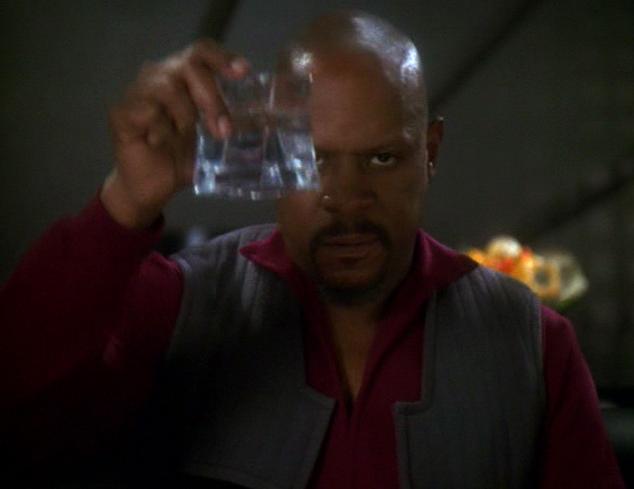
Cool Stuff: 3 points. The Romulan shuttle is a first for the design. This is the second episode in a row in which Weyoun only appears as a hologram. I also believe that this is the first episode where we see the character describing everything that happened as a log entry. For me, the coolest part of the episode is Sisko’s monologue at the end. He describes all of his sins, and then says he would do it again. He defiantly raises a glass and says he can live with what he has done, then lowers it and more softly repeats the line as if he is trying to convince himself, before finally deleting the entire log. It’s as if we are the only witnesses to the Confession of Benjamin Sisko.


Rank: Admiral (23 points) – This episode consistently ranks in the Top 10 of DS9 episodes, and it is with good reason. Trek is at its finest when it focuses on the characters, and this is an episode that shows how to move the overarching story with a good character tale. Fine acting on the part of Avery Brooks, well-crafted story, and it provides the catalyst for swinging the momentum of the Dominion War. This episode is a must watch for casual fans.


If you would like to read other reviews from Star Trek: Deep Space Nine, please click the following link.

If you would like to read an episode review from any of the Trek series, click the following link to get to the series catalog. If the episode you want reviewed has not been done yet, then feel free to request it in the comments and I will see what I can do.

Blogger's note: Upon reflection of some of the feedback I received, I have updated the scoring for this episode. I was initially worried that my bias towards Deep Space Nine caused me to be overly generous with scoring, so I only scored the episode a 9/10. I have heard from many who feel that this episode was nearly perfect, and I decided to increase the score to a 10.